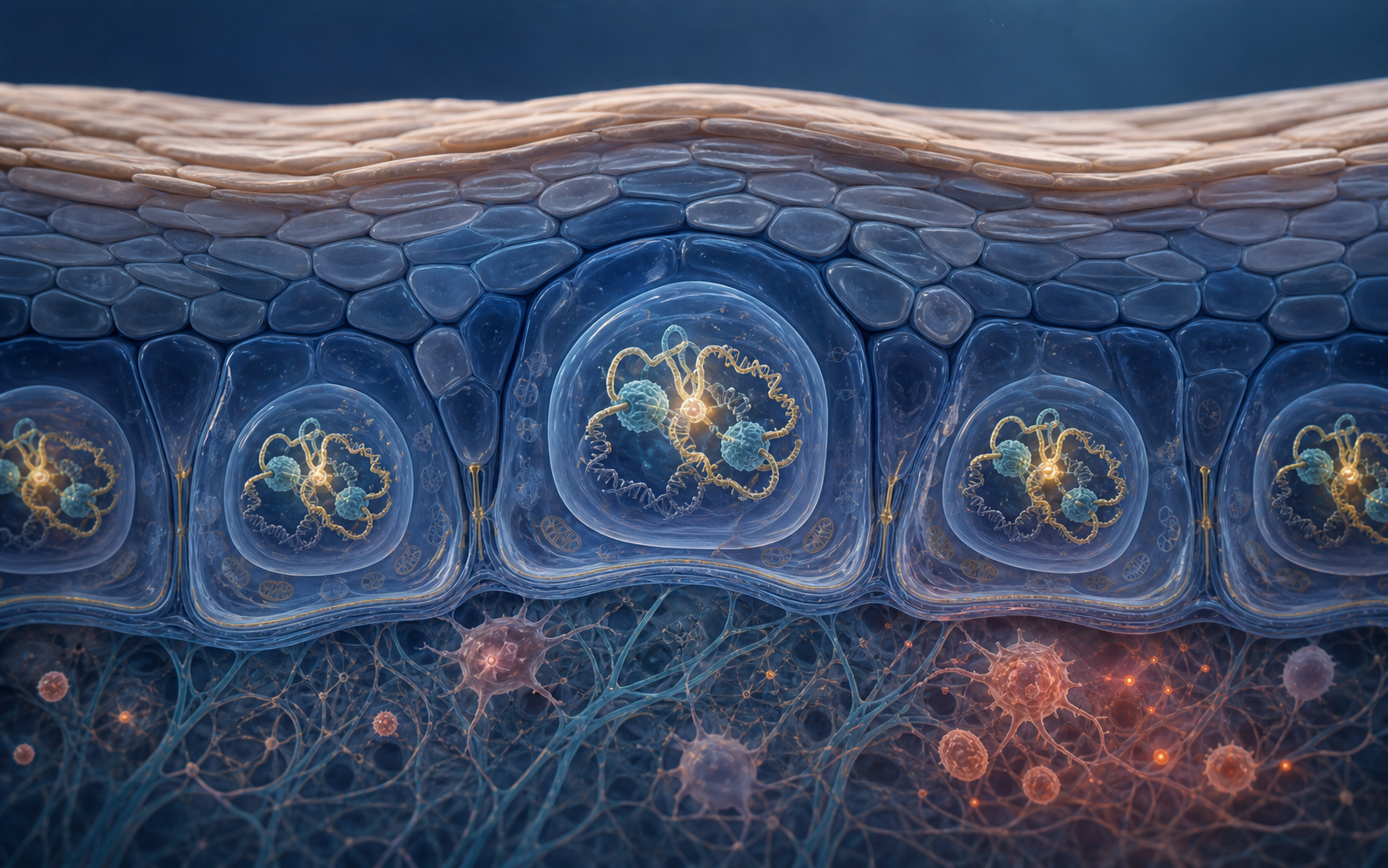
The bottom line: A mouse study found that BMAL1, best known as a circadian clock protein, can work with YAP outside its normal timekeeping role to amplify inflammation in aged skin. The finding adds a mechanistic link among tissue mechanics, immune signaling and age-related loss of skin homeostasis.
Aging skin heals more slowly, maintains a weaker barrier and often shows persistent low-grade inflammation. Those changes are produced by many interacting cell types and signals, making it difficult to identify which mechanisms keep the inflammatory program active.
In a study published in Nature Aging, researchers examined gene regulation in the mouse epidermis across the day. They found that aging changed how BMAL1 occupied enhancer regions, but the important shift was not simply a broken circadian rhythm.
A second job for a clock protein
BMAL1 cooperated with YAP, a protein that responds to mechanical and growth signals. In young epidermis, the partnership helped regulate genes involved in tissue identity and homeostasis. In aged skin, BMAL1 and YAP increasingly occupied enhancers linked to inflammation.
The inflammatory cytokine IL-17 activated YAP through a route that did not depend on its usual Hippo pathway. Some of the resulting genes were also regulated by NF-kB, a central inflammatory transcription factor. Together, these changes created a persistent program rather than a brief response to damage.
Why this matters
The work connects three features of tissue aging that are often studied separately: changes in the extracellular environment, altered gene regulation and chronic immune activity. It also shows why a molecule should not be reduced to its best-known function. BMAL1 can participate in gene regulation that is distinct from its role in the circadian clock.
That distinction matters for future interventions. A strategy aimed broadly at suppressing BMAL1 could disrupt normal circadian biology. A more plausible route would target the age-specific BMAL1-YAP interaction or an upstream inflammatory signal in the relevant tissue.
The limits
The study was conducted in mice and did not test a treatment that restored skin function. Human skin differs in structure, exposure and immune environment. More work is needed to confirm the enhancer program in human samples and determine whether modifying it improves wound healing or barrier integrity.
The Lifespan Brief assessment
This is a strong mechanistic study of skin aging. It identifies a specific transcriptional partnership, but it remains a target-discovery result rather than evidence for a therapy or lifestyle intervention.
Primary source
- Noncircadian BMAL1-YAP activity amplifies persistent inflammation in aged epidermis, Nature Aging, August 19, 2026.