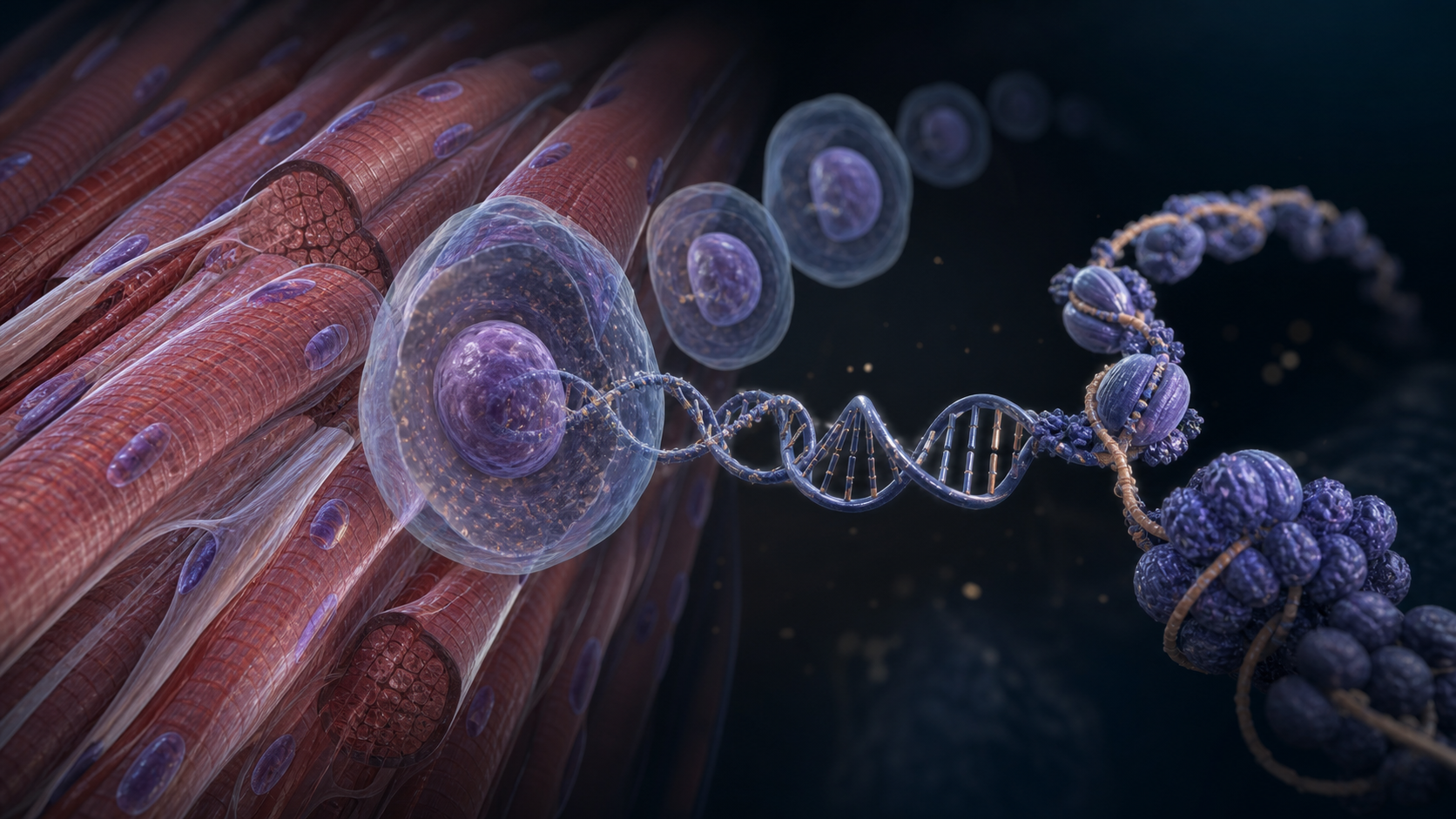
A large analysis of human skeletal muscle suggests that aging is accompanied by extensive changes in which parts of DNA remain readily available for cells to use. The researchers found 4,061 age-associated regions of chromatin, the DNA-protein material packed inside the nucleus, across 467,126 individual nuclei from 287 muscle samples.
The pattern was especially notable in muscle fibers. Regions that became less accessible with age outnumbered those that opened, and many of the closing regions were active enhancers, stretches of DNA that help regulate when and how strongly genes are used. Some of the affected regions contained binding sites for glucocorticoid and androgen receptors, hormone-responsive proteins involved in maintaining muscle metabolism and function.
The study used human tissue, but it was observational and molecular. It does not show that reduced chromatin accessibility causes sarcopenia, nor does it identify a therapy that restores muscle function. The work was posted on bioRxiv and has not completed peer review.
Evidence at a glance
- Study type: Cross-sectional analysis of single-nucleus gene expression and chromatin accessibility in human skeletal muscle.
- Population: 287 donors aged 20 to 79, contributing 467,126 nuclei across 13 cell types.
- Evidence level: Early Research. This is a preprint.
- Main finding: Researchers identified 384 age-associated genes and 4,061 age-associated chromatin regions. Closing chromatin was more common than opening chromatin across muscle fiber types and sexes.
- Main caution: Associations with age do not establish that the chromatin changes drive muscle decline, and no intervention was tested.
What chromatin accessibility means
DNA is not stored as a loose strand. It is wrapped around proteins and folded into chromatin. Some regions are arranged in a relatively open state, making it easier for the cell’s regulatory machinery to reach them. Other regions are packed more tightly and are harder to access.
A useful analogy is a reference book with some pages open and others held shut. Accessibility changes how easily the cell can consult a section, but it does not mean that a gene is permanently switched on or off. Gene activity also depends on transcription factors, chemical signals, cell state and many other layers of control.
The researchers measured accessibility with single-nucleus ATAC-seq, a method that maps open chromatin in individual cell nuclei. They paired it with single-nucleus RNA sequencing, which measures gene-expression patterns. Analyzing both layers allowed the team to ask whether aging-related regulatory changes were visible before or without a matching change in RNA.
A population-scale view of aging muscle
The samples came from adults spanning roughly six decades of life. By resolving nuclei into 13 cell types, the analysis could separate changes in muscle fibers from those in blood-vessel cells, immune cells and resident support cells.
Across the dataset, the team identified 384 genes whose expression was associated with age and 4,061 chromatin regions whose accessibility was associated with age. The molecular features were enriched in pathways related to metabolism, communication between cells and cellular senescence, a stress response in which cells stop dividing and can release inflammatory signals.
Those counts describe statistical associations, not thousands of proven aging switches. A chromatin region can influence more than one gene, and a nearby gene is not necessarily the region’s true target.
Muscle fibers showed a broad closing pattern
Age-associated closing was more common than opening across muscle fiber types and in both sexes. The closing regions were enriched in active enhancers and were less common at active transcription start sites, the places where cells begin copying DNA into RNA.
The authors also found that closing regions were enriched for sequence motifs recognized by glucocorticoid and androgen receptors. Motifs are short DNA patterns that can be bound by regulatory proteins. Their presence does not prove that a receptor was bound or that hormone signaling failed. It identifies a plausible regulatory pathway for follow-up experiments.
That distinction matters because glucocorticoids and androgens have complex effects on muscle. Both influence protein turnover, metabolism and adaptation, and their effects depend on dose, timing, sex and physiological context. The preprint shows that relevant regulatory sites become less accessible with age. It does not show that hormone treatment would reopen them or improve muscle health.
What gene expression alone did not reveal
One of the study’s most important observations was the mismatch between the two molecular layers. Many age-associated accessibility changes did not have an obvious counterpart in the matched gene-expression data.
Gene expression is a snapshot of which RNA molecules are present when tissue is sampled. Chromatin accessibility describes part of the regulatory landscape that helps determine how a cell can respond. A region could become less available without producing a large change in resting RNA levels, yet still alter how the cell responds to exercise, injury, nutrients or hormones.
This is why the authors describe an erosion of regenerative regulation rather than a simple list of genes that rise or fall with age. The chromatin data may reveal reduced regulatory flexibility that RNA measurements alone miss. That idea remains a hypothesis until experiments test how the affected regions behave under stress or during repair.
Why this could matter for sarcopenia
Sarcopenia is the age-related loss of muscle mass, strength and physical performance. It develops through many interacting processes, including changes in motor neurons, hormones, inflammation, physical activity, nutrition, blood flow and the muscle’s capacity to repair itself.
A less accessible enhancer landscape could help explain why older muscle responds differently to anabolic hormones, injury or exercise. It could also help researchers identify cell types and regulatory regions that deserve functional testing. That is a map for future work, not a demonstrated treatment pathway.
The finding complements recent efforts to understand muscle as both a mechanical and signaling organ. In a separate animal study, researchers found systemic effects from self-contracting muscle grafts in mice. Neither study shows how to reverse human muscle aging, but together they illustrate how muscle structure, activity and molecular regulation reach beyond strength alone.
Limitations
The analysis was cross-sectional, meaning it compared different people at different ages rather than following the same individuals over time. Age can therefore be entangled with differences in health, medication, activity, diet, body composition and life history. Statistical adjustment can reduce some confounding but cannot remove it completely.
The samples also came from a defined cohort and tissue collection process, so replication in populations with different ancestry, health status and activity patterns will be important. A biopsy captures one muscle at one moment. It cannot show how accessibility changes after exercise, injury or treatment.
Finally, ATAC-seq identifies regions that are more or less accessible, but it does not by itself prove which protein binds there, which gene is affected or whether the change alters muscle performance. The preprint has not yet been peer reviewed, and one author disclosed a research grant from Pfizer.
What the research does not show
This study does not demonstrate that closing chromatin causes muscle weakness, frailty or sarcopenia. It does not show that the affected regions can be safely reopened, and it does not test a drug, supplement, diet or exercise program.
It also does not establish that a molecular change associated with age shortens life or that reversing the change would extend healthspan. Chromatin accessibility is one layer of regulation inside a much larger biological system.
What researchers need to demonstrate next
Longitudinal studies could determine whether the same regulatory regions change within individuals as they age and whether those changes predict declining strength, recovery or metabolic health. Replication in independent cohorts would test how general the pattern is.
Functional experiments are the critical next step. Researchers could perturb selected enhancers in human muscle cells or organoid models, measure the target genes they control and test responses to hormones, contraction and injury signals. Carefully designed exercise or rehabilitation studies could also ask whether accessibility at these regions is stable or modifiable.
The Lifespan Brief assessment
This is a substantial human tissue map showing that age-related molecular change in muscle extends beyond gene expression. Its strongest contribution is the discovery of a broad, cell-specific loss of accessibility at regulatory regions that standard RNA measurements often did not reveal.
The evidence is early and associative. The study helps define where researchers should look, but it does not establish why the regions close, whether they drive sarcopenia or how to reverse them. The next advance will require experiments that connect specific chromatin changes to muscle function.
Sources
Moo and colleagues, Erosion of regenerative regulation: age-associated shifts in the skeletal muscle fiber epigenome and transcriptome, bioRxiv, posted August 27, 2026. Preprint, not peer reviewed.
Varshney and colleagues, Population-scale skeletal muscle single-nucleus multi-omic profiling reveals extensive context specific genetic regulation, bioRxiv, version 2 posted December 17, 2024. Preprint, not peer reviewed.