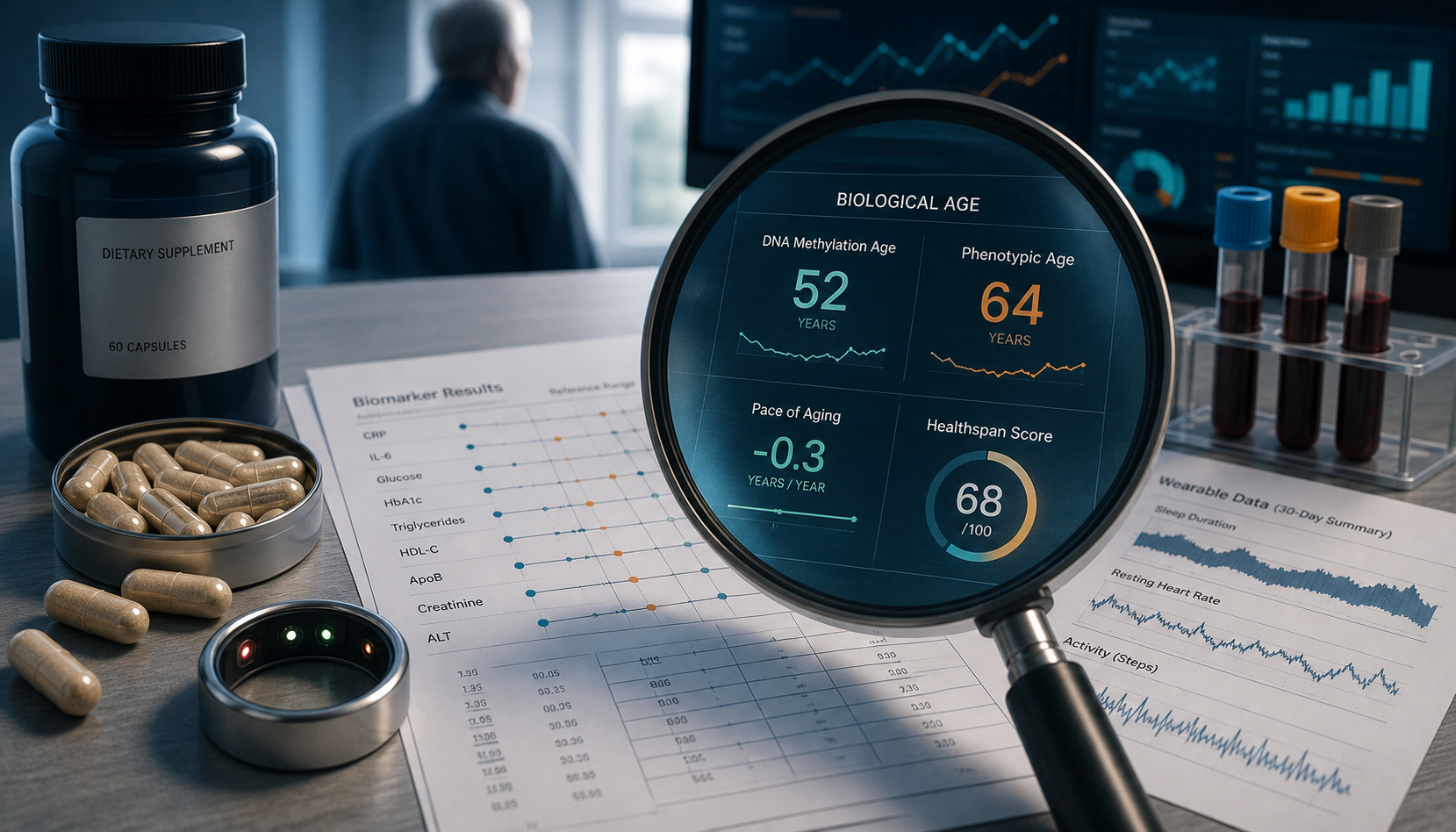
The claim: AgelessRx says a 90-day combination program improved biological age, sleep, quality of life, immune measures and lean-mass preservation in older adults.
The evidence: The pilot was randomized and included a control group, but only 18 participants were included in the final analysis. The public results come from the company, multiple treatments were bundled together, and several outcomes improved in the control group too. The study can generate hypotheses. It cannot show that the program slowed aging or extended healthspan.
What AgelessRx tested
The 90-day pilot was conducted as part of the semifinal stage of the XPRIZE Healthspan competition. AgelessRx enrolled 26 adults ages 60 to 80 who had indicators of functional decline. Eighteen participants were included in the final analysis, with five in the control group, seven in a multi-therapy group and six in a comprehensive-therapy group.
The control group received vitamins C and E, general exercise guidance and a listening activity. The multi-therapy group received low-dose naltrexone, metformin, an NAD+ nasal spray, vitamin B12, structured exercise and guided meditation. The comprehensive group received the same program plus low-dose rapamycin, a glutathione patch and a branded supplement.
This is a bundled intervention. If an outcome changes, the design cannot identify whether the cause was a drug, supplement, exercise, meditation, interaction among treatments, greater attention from the study team or chance.
What the company reported
AgelessRx reported that PhenoAge declined in all three groups, with larger average reductions in the active groups. PhenoAge is a calculated estimate based on ordinary blood measurements associated with mortality risk. It is useful in research, but a reduction of 1.84 PhenoAge years is not the same as living 1.84 years longer or reversing the body by that amount.
Sleep and self-reported quality-of-life scores improved more often in the active groups. Lean mass was roughly maintained in both active groups while the five control participants lost an average of 1.75 kilograms. Participants with low baseline immune questionnaire scores moved into the normal range in the active groups.
Cognitive testing and aerobic-fitness results were mixed. Seven of the 26 enrolled participants experienced at least one adverse event, and three withdrew. One serious adverse event, a heart attack in the multi-therapy group, was assessed as possibly related to physical activity.
Why the numbers require caution
A randomized control is a strength, but randomization cannot overcome an extremely small final sample. With five to seven people per group, one unusual participant can substantially change an average. The company itself noted that the control group’s sleep result was affected by an outlier.
The attrition is also important. Eight of 26 enrolled participants were not included in the final analysis. Results can be biased if people who do not complete a study differ from those who do. A rigorous report should explain every exclusion, compare baseline characteristics and include an intention-to-treat analysis when possible.
There were many outcomes, including blood tests, metabolic measures, body composition, wearable data, cognition, aerobic fitness and several questionnaires. Testing many endpoints increases the chance that some will look favorable by coincidence. Public materials do not yet provide a peer-reviewed statistical analysis that allows readers to judge multiple-comparison corrections, missing data and prespecified primary outcomes.
Company evidence is not automatically bad evidence
AgelessRx designed and oversaw the interventions, sells longevity-related services, and reported the results on its own website. That is a clear conflict of interest, but it does not mean the data should be dismissed. Companies often fund early clinical development because no one else will.
The right response is to ask whether the protocol was registered, whether outcomes were selected in advance, whether the full dataset and analysis are available, and whether independent researchers can reproduce the result. The trial is registered at ClinicalTrials.gov, which is useful. A peer-reviewed paper with participant-level reporting would make the claims easier to evaluate.
What would count as stronger evidence
A larger trial should compare clearly defined groups, use an intervention that can be replicated, and specify primary outcomes before analyzing the data. It should retain most participants, report adverse events in detail and last long enough to measure durable changes.
Functional outcomes matter more than a lone aging score. Strength, endurance, cognition, infection rates, falls and independence can tell researchers whether people are actually healthier. Biomarkers can help explain a result, but they should not replace it.
The Lifespan Brief verdict
AgelessRx completed a complicated randomized pilot and produced signals worth testing. That is a legitimate achievement, and selection as an XPRIZE Healthspan finalist supports the value of advancing the program to a more rigorous stage.
The public evidence does not support the claim that a 90-day stack improved healthspan or slowed human aging. The sample is too small, the intervention is too bundled, the follow-up is too short and the analysis is not yet independently peer reviewed. For now, this is a promising feasibility result packaged in language that sometimes outruns what the trial can prove.
Sources
- AgelessRx and XPRIZE Healthspan Semi-Finals: Our 90-Day Trial Findings, AgelessRx, September 2, 2026.
- ClinicalTrials.gov record NCT07475546.
- XPRIZE Healthspan competition overview.
This article is for general information and is not personal medical advice.