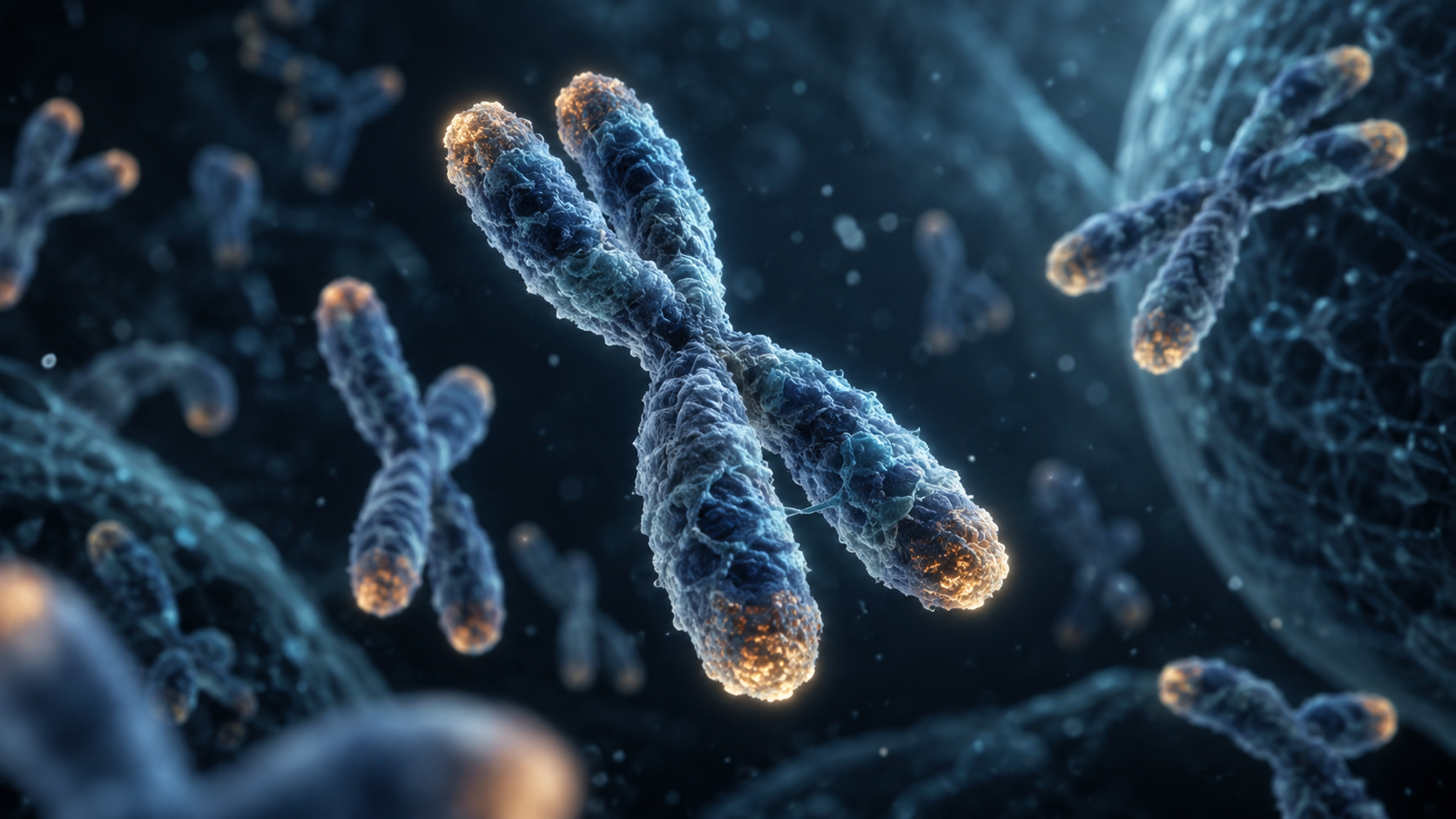
For years, telomeres were described as something close to a biological countdown clock. The shorter they became, the closer we supposedly moved toward old age and death. The science is more complicated than that.
At the ends of every chromosome in your body sit tiny structures called telomeres.
If you have heard about them before, there is a good chance someone compared them to the plastic tips on shoelaces.
It is not a perfect analogy, but it works.
Just as those plastic caps help stop a shoelace from fraying, telomeres protect the ends of our chromosomes. As many of our cells divide again and again over the course of our lives, their telomeres gradually become shorter.
And shorter and shorter and shorter.
Eventually, some become so short that the cell receives what amounts to a warning: stop dividing.
It is easy to see why telomeres became associated with aging.
If telomeres get shorter as we get older, and cells eventually stop dividing when telomeres become critically short, perhaps telomeres are the clock counting down our remaining years.
Keep them long, the thinking went, and maybe we could stay younger for longer.
That idea turned out to be far too simple.
Telomeres really do shorten as we age
Telomeres are clearly connected to aging.
A large systematic review and meta-analysis involving more than 743,000 people found the expected overall pattern: telomere length tends to decline with chronological age. But there was also considerable variation between people and studies, influenced partly by the tissue being measured and the method researchers used to measure telomeres.
Two healthy 60-year-olds can have meaningfully different telomere lengths.
Measuring someone’s telomeres is not the biological equivalent of looking at the odometer on a car.
A telomere test cannot tell you:
You have 17 years left.
Nor can it reliably tell you that one person with longer telomeres is biologically younger than someone with shorter ones.
Telomeres tell us something about what is happening inside our cells.
They do not tell us how old the entire body is.
Why do telomeres shorten?
Every time a cell copies its DNA in preparation for dividing, it has difficulty copying the absolute ends of its chromosomes. Telomeres provide expendable DNA that helps protect the important genetic information farther inside.
Eventually, enough telomere can disappear that the chromosome end begins to resemble damaged DNA.
The cell may then stop dividing.
Some cells enter senescence, a state in which they remain alive but no longer divide normally.
Others die.
You might wonder why evolution left us with a system that gradually limits the ability of cells to reproduce.
One reason appears to be cancer.
Shortening telomeres can help protect us from cancer
Cancer depends on cells continuing to divide when they should not.
A cell becoming cancerous therefore faces a problem. After enough divisions, its telomeres become dangerously short.
That can stop the cell from dividing any further.
A 2026 review in Nature Reviews Genetics described telomere shortening as an important tumour-suppressor mechanism. Critically short telomeres can help stop potentially cancerous cells from reproducing indefinitely.
The same process that contributes to some problems of aging may therefore also protect us from cancer.
The question is no longer simply how to prevent telomeres from becoming shorter.
The harder question is how long we actually want them to remain.
Cancer cells have found a way around the limit
Your body produces an enzyme called telomerase.
In simple terms, telomerase can rebuild and maintain telomeres.
It is active in certain cells that need to reproduce frequently, but its activity is tightly controlled in much of the adult body.
Many cancer cells manage to reactivate it.
That allows malignant cells to maintain their telomeres and continue dividing when normal cells would eventually have stopped.
The ability to maintain telomeres is one of the tools cancer cells use to become, in effect, biologically immortal.
Short telomeres can contribute to aging and disease.
Keeping telomeres from becoming short can also allow dangerous cells to keep reproducing.
Longer is not always better
People who are genetically predisposed to having longer telomeres do not simply have better health across the board.
Research has connected genetically longer telomeres with increased risk of several cancers.
A 2025 Mendelian randomization study used genetic variants associated with telomere length to investigate whether telomere length itself might influence disease risk. In the populations studied, genetically longer telomeres were associated with higher risks of several cancers, including particularly strong associations with thyroid and lung cancers.
Other studies have found similar patterns.
A cell with longer-lasting telomeres has more opportunity to keep dividing. That may help healthy tissues maintain themselves, but it can also give a damaged cell additional opportunities to acquire the mutations and other changes needed to become cancerous.
The body appears to be balancing two competing problems: maintaining tissues and limiting uncontrolled cell growth.
Were scientists wrong about telomeres and aging?
No.
Critically short or dysfunctional telomeres can cause serious problems.
People with rare inherited disorders affecting telomere maintenance can develop diseases involving the bone marrow, lungs, immune system and other tissues. These conditions provide some of the strongest evidence that telomeres are genuinely important to human health.
Telomere dysfunction can also contribute to cellular senescence, inflammation and declining tissue function.
What has changed is the idea that telomeres are the clock of aging.
Aging involves changes in DNA, proteins, mitochondria, the immune system, metabolism, stem cells, the epigenome and communication between cells.
Telomeres are one part of that process.
An important part, but not a master clock counting down to death.
Can you lengthen your telomeres?
Claims about protecting or lengthening telomeres have appeared around supplements, diets, exercise programs and other lifestyle interventions.
Some lifestyle factors are associated with telomere length. People who exercise, eat well, sleep adequately and avoid smoking may have different telomere patterns than people who do not.
But association is not the same as proof that changing one behaviour lengthened the telomeres or slowed aging.
People who exercise regularly, for example, may also eat differently, have different incomes, receive better healthcare or differ in many other ways.
There is another problem.
Even if an intervention genuinely increases telomere length, researchers still need to show that doing so reduces disease, preserves health or extends life.
Longer telomeres are not automatically better telomeres.
Trying to maximize telomere length without understanding the consequences could interfere with one of the body’s safeguards against cancer.
The more realistic goal is healthy tissue maintenance without allowing damaged cells to divide without restraint.
So, does the Grim Reaper still hide within our telomeres?
A little.
Just not in the way people once imagined.
Telomeres really do shorten with age. When they become critically short or dysfunctional, cells can stop dividing, tissues can lose some of their regenerative ability and disease can follow.
But telomere shortening also helps prevent cells from reproducing forever.
That leaves our bodies balancing two risks.
Telomeres that become too short can create problems.
Cells that maintain their telomeres indefinitely can create very different ones.
The secret to a longer life may not be keeping our telomeres as long as possible.
It may simply be keeping them long enough, but not too long.
Sources
- Ye Z, et al. Telomere length and chronological age across the human lifespan: A systematic review and meta-analysis of 414 study samples including 743,019 individuals. Ageing Research Reviews. 2023.
- Hockemeyer D, Maciejowski J. How telomere attrition protects against cancer. Nature Reviews Genetics. 2026.
- Maciejowski J, de Lange T. Telomeres in cancer: tumour suppression and genome instability. Nature Reviews Molecular Cell Biology. 2017.
- Lee J, et al. The Causal Relationship between Telomere Length and Cancer Risk: A Two-Sample Mendelian Randomization. Cancer Epidemiology, Biomarkers & Prevention. 2025.
- Armanios M. The Role of Telomeres in Human Disease. Annual Review of Genomics and Human Genetics. 2022.
This article is for general information and is not personal medical advice.