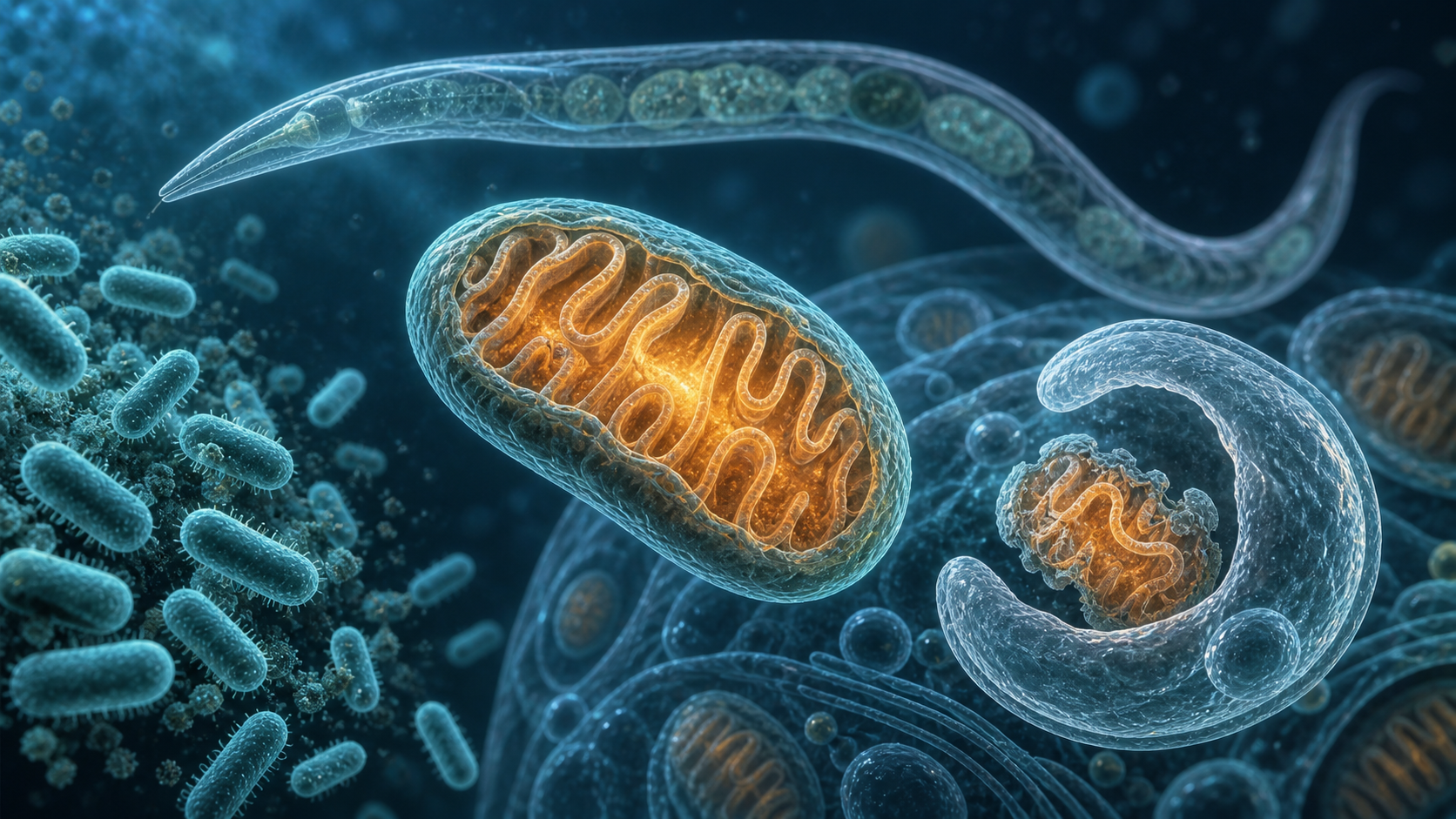
Changing a gene helped worms live longer, but the effect depended on what their bacterial food supplied. A new Nature Communications study links that interaction to the recycling of mitochondria, the cell’s energy-producing structures.
This was research in Caenorhabditis elegans, not people. It does not establish that vitamin B12, methionine, supplements or any particular diet extends human lifespan.
The diet changed the result
Worms lacking functional rict-1 benefited from B12-rich bacteria with sufficient methionine. Ordinary worms did not gain the same lifespan benefit from switching bacterial diets. The paper, published September 14, 2026, traces the response through B12-dependent enzymes, METR-1 and MMCM-1, to increased succinate, a metabolic intermediate.
What RICTOR does
RICTOR is a component of mTORC2, a group of proteins that helps cells coordinate growth and metabolism. Think of a protein complex as a working team: its members cooperate to pass signals, rather than each acting as an independent switch. mTOR also belongs to a different team called mTORC1. The two complexes have distinct structures and roles.
That makes “turn down mTOR” an incomplete description. Which complex changes, in which tissue, and under which conditions can affect the outcome. A review of mTORC2 regulation describes how growth signals, nutrients and metabolites influence this network. A gene manipulation in a laboratory animal should therefore not be read as a ready-made drug strategy.
Why breaking mitochondria apart can help
Succinate promoted mitochondrial fragmentation and mitophagy. Blocking the cleanup machinery removed the mutant worms’ longevity advantage. Despite early fragmentation, these worms retained more tubular mitochondria later in life.
Mitochondria are dynamic structures. They can join together through fusion and divide through fission. Fragmentation describes a network shifting toward smaller pieces. Mitophagy is selective recycling: cellular machinery captures mitochondria and sends them for breakdown. Division and disposal are different steps. Smaller pieces alone do not show that cleanup is working.
The useful question is whether the cell can keep a functioning population of mitochondria over time. That requires coordinating repair, division, recycling and replacement. A 2026 review in Nature Metabolism explains why this quality control matters beyond energy production: mitochondria also participate in inflammation, stress responses and cellular signalling. When maintenance fails, those wider functions can suffer.
What would need to happen next
For a reader interested in living longer, the next experiments would need to answer several separate questions. Does a comparable interaction occur in mammalian cells and animals? Can it be changed safely in adulthood? Does any benefit persist across different diets, sexes and genetic backgrounds?
Researchers would also need to measure trade-offs. An intervention that improves one cellular process could still harm another. Longer survival, preserved physical function and acceptable safety would all need testing; an attractive mitochondrial image or a changed molecular marker would not settle those questions.
Eventually, a human intervention would require controlled clinical studies with meaningful health outcomes. A mechanism can tell researchers where to investigate. Clinical evidence must show whether acting on that mechanism actually helps people. Those are different research tasks.
The takeaway
Treat this as a research lead, not a shopping list. The practical question is whether a safe intervention can produce a meaningful benefit in humans. That answer requires evidence from humans.
Featured image: original AI-generated conceptual illustration. It is not a microscopy image or a depiction of a proven treatment.