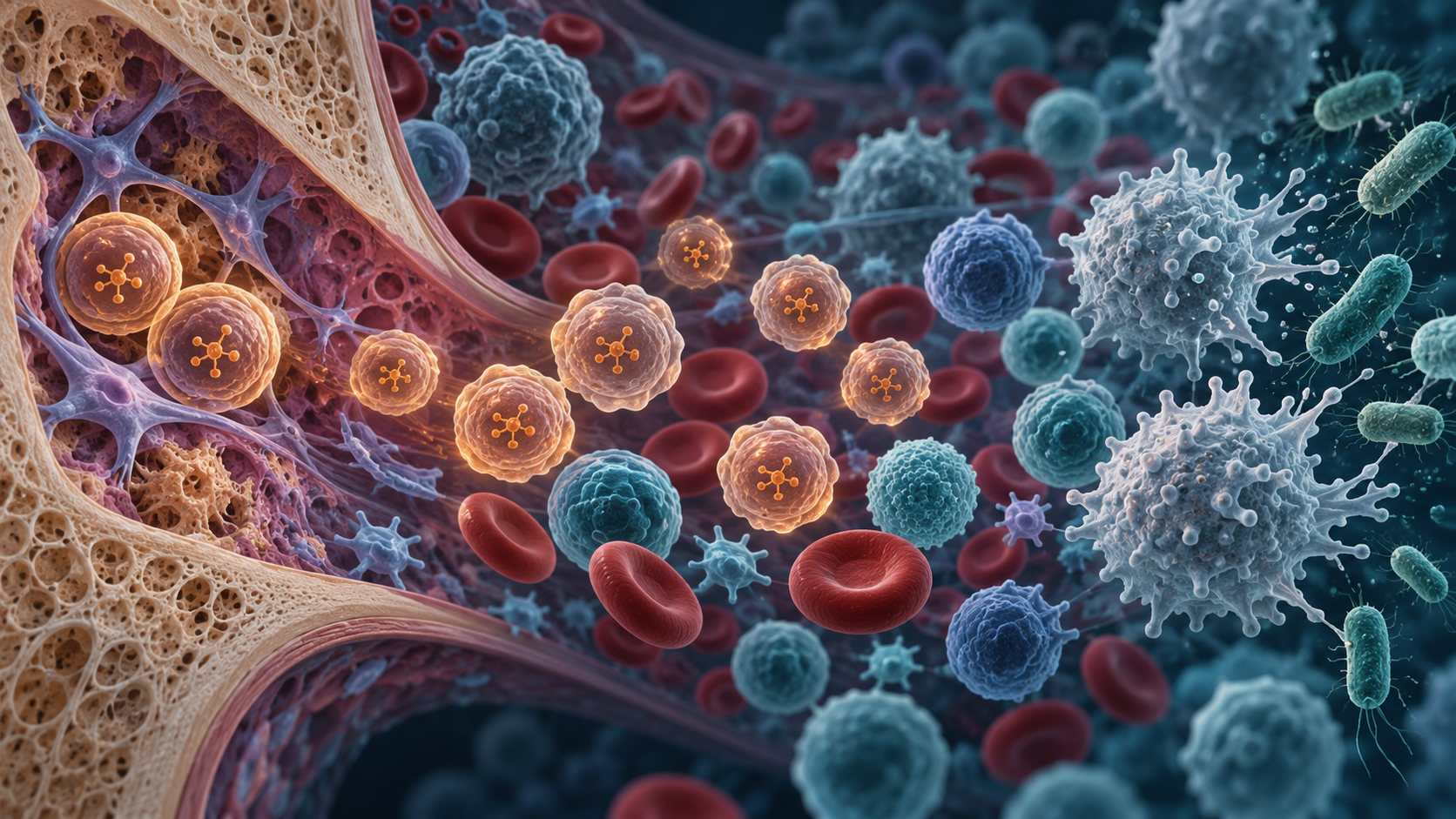
AI-generated editorial illustration of clonal blood-cell expansion and infection vulnerability. Illustrative, not experimental evidence.
The bottom line: Aging can change the composition of our blood before a blood cancer develops. A new human study links one such change, clonal haematopoiesis, to a higher rate of serious bacterial infection. The average association was modest, but some uncommon mutations and large clones carried much greater risks. This is observational evidence, not proof that the mutations caused infection.
The study, published October 7 in Nature Communications, asks whether expanding groups of mutated blood cells could help explain differences in infection resilience. Its clearest message is that clonal haematopoiesis is heterogeneous: the gene involved and the size of the clone matter.
What clonal haematopoiesis means
Blood-forming stem cells in bone marrow continually replenish blood and immune cells. During life, some acquire DNA mutations. A mutation that gives a stem cell a growth or survival advantage can allow its descendants to become an unusually large share of the blood-cell population. Those related descendants form a clone.
This process becomes more common with age, as mutations accumulate and selected clones have time to expand. Clonal haematopoiesis, or CH, is not itself a diagnosis of blood cancer. Some clones are associated with increased cancer risk, but detecting a clone does not mean that cancer is present or inevitable.
Five cohorts, with different roles
Eleanor Fewings and colleagues analyzed sequencing and clinical data from UK Biobank, Genomics England and the Alliance for Genomic Discovery in a discovery sample of 590,537 people. They identified 19,822 distinct mutations across 43 CH-associated genes in 40,560 participants, or 6.87% of that sample. The most frequently mutated genes included DNMT3A, TET2 and ASXL1.
The discovery cohorts contained 448,083, 50,243 and 92,211 participants, respectively. Their median ages were 58, 49 and 60 years. Validation added 245,333 All of Us participants and 53,345 Mass General Brigham Biobank participants, bringing the combined analysis to 889,215.
The full 889,215-person dataset was not one uniform prospective study. Discovery analyses used clinical records to follow disease after blood collection; the five-cohort validation used cross-sectional logistic models because follow-up and phenotype data differed. The discovery cohorts had median follow-up of 169, 73 and 133 months.
The infection association
Serious bacterial infection was defined using diagnostic codes, including sepsis and pneumonia. The supplementary code list also included pneumonia with an unspecified organism, so the endpoint should not be interpreted as requiring laboratory-confirmed bacteria in every case.
In the discovery analysis, any CH was associated with a hazard ratio of about 1.22 for serious bacterial infection, with a 95% confidence interval of 1.18 to 1.27. That describes a roughly 22% higher relative hazard over follow-up, not a 22-percentage-point increase in an individual’s probability of infection. Larger expanded clones had an overall hazard ratio of about 1.49.
Age and sex were included in the main models. Sensitivity analyses considered nonlinear age effects, genetic ancestry, and existing coronary heart, kidney and liver disease. Associations persisted after excluding prior cancers and, in UK Biobank, several low-blood-count disorders. Smoking was included in the separate proteomic analysis, not listed as a covariate in the main infection models.
Mutation and clone size made a substantial difference
The researchers used variant allele fraction, the proportion of sequencing reads carrying a mutation, as a marker of clone size. They classified fractions up to 10% as small, above 10% through 40% as medium, and above 40% as large. This is a sequencing measure, not a direct count of all mutated cells.
Large clones involving the RNA-splicing genes SRSF2 and SF3B1 showed some of the strongest associations. In modeled discovery estimates, about 25% of carriers of large SRSF2 P95 clones developed serious bacterial infection within 10 years. That subgroup contained only 55 people. The comparable estimate for large DNMT3A R882 clones was about 9%, based on 71 carriers. These estimates describe selected subgroups and should not be generalized to everyone with CH.
What the mortality analysis showed
Supplementary Data 14 reports that carriers of medium or large clones involving the five selected mutation hotspots had higher mortality within 28 days of an infection diagnosis than the overall infection group: relative risk 1.38, with a 95% confidence interval of 1.05 to 1.83. For SRSF2 P95, the reported relative risk was 1.77, with a 95% confidence interval of 1.14 to 2.74. The models adjusted for age and sex; these mortality comparisons were not corrected for multiple testing.
A source caveat matters here. The early accepted manuscript’s abstract reports a different overall mortality estimate, and its results text also differs from Figure 4 and Supplementary Data 14. We use the explicitly defined supplementary analysis above rather than treating the abstract estimate as interchangeable.
A mechanism remains to be established
Mutations in splicing factors can affect how cells process RNA and how blood-cell progenitors develop. An exploratory proteomic analysis also found altered FLT3 receptor and ligand levels in CH carriers, suggesting changes in blood-forming-cell signaling. Classical inflammatory cytokines IL-6 and TNF did not show significant differences after multiple-testing correction.
These observations offer possible biological leads. They do not demonstrate how a particular clone weakens antibacterial defenses. Infection and immune stress might also help select or expand clones over time, making the direction of the relationship more complicated.
The Lifespan Brief assessment
The large sample, replication and mutation-specific patterns strengthen the association. Limitations include retrospective diagnostic records, different sequencing and follow-up across cohorts, possible residual confounding, and small numbers in the highest-risk subgroups. Cancer exclusions reduce one explanation for the findings but cannot establish causation or exclude all undiagnosed disease.
The study supports further research into CH as a marker of infection vulnerability. It does not establish population screening for this purpose, show that removing a clone prevents infection, or identify a treatment that improves resilience. Prospective studies and experiments must test mechanisms and whether mutation-specific information adds useful clinical value.
Primary source
Fewings E, Yu Z, Gutierrez JC, et al. Clonal haematopoiesis subtypes confer dose-dependent risk of serious bacterial infection. Nature Communications. Published October 7, 2026. DOI: 10.1038/s41467-026-77934-x. Open-access accepted manuscript; see the linked Supplementary Data 14 and 21 for mortality results and diagnostic definitions.
The team includes researchers at Illumina, the Broad Institute, Massachusetts General Hospital and Harvard Medical School, Memorial Sloan Kettering, Vanderbilt University Medical Center and the VA Boston Healthcare System. Several authors were Illumina employees; the paper discloses additional financial relationships.