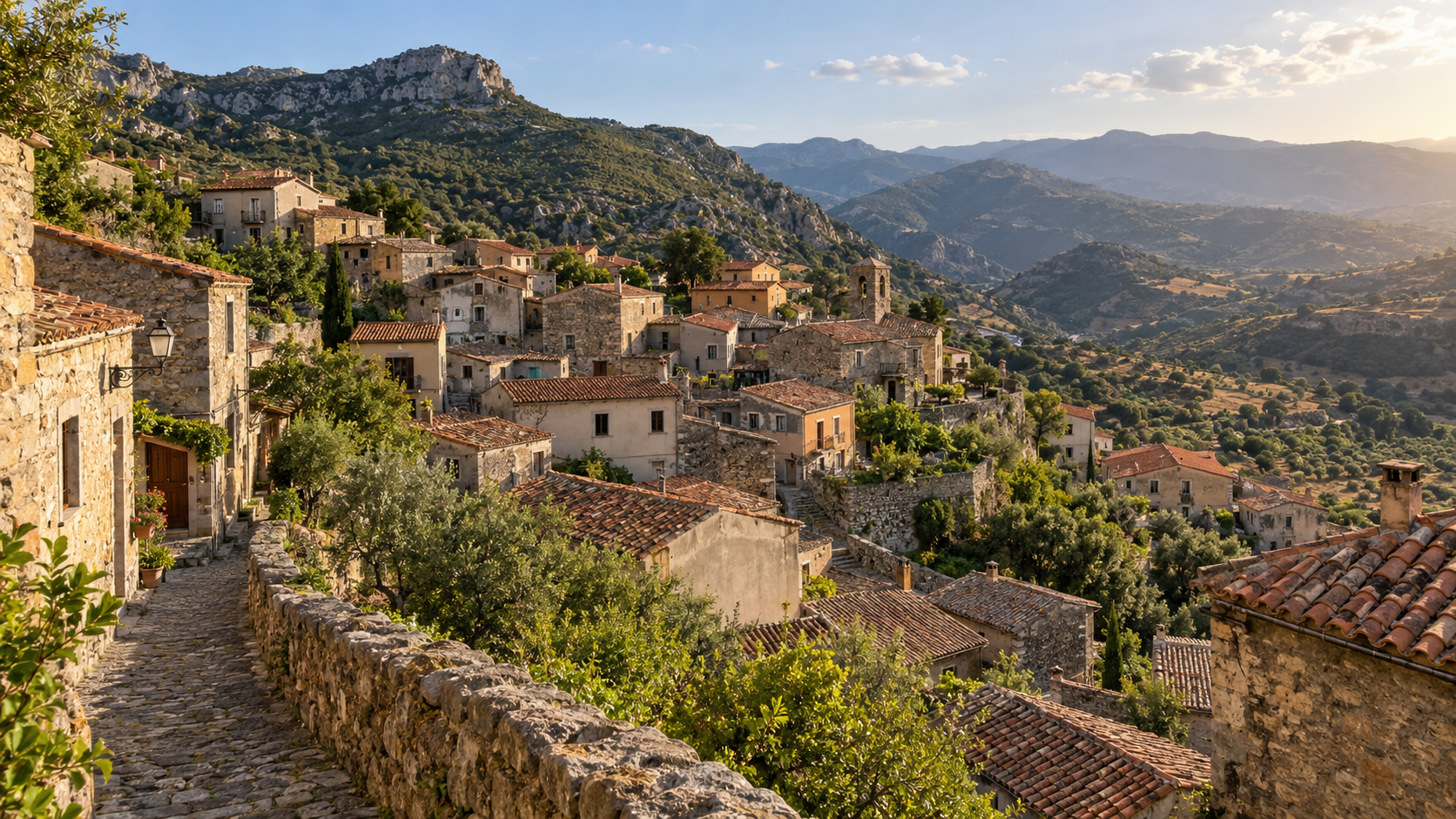
Bolotana, a small mountain village in central Sardinia, has attracted researchers’ attention for an unusual pattern of survival among older women. Its civil and church archives offer a way to examine that pattern using documented ages rather than anecdotes.
A freely accessible study in Frontiers in Aging, published October 5, 2026, reports a high estimated probability of surviving from age 70 to 100 under the village’s recent mortality conditions. The result makes Bolotana a candidate for further longevity research. The authors explicitly say the evidence does not yet justify classifying it as an established longevity blue zone.
What the 13.8% figure means
The main analysis used deaths and time lived by registered residents aged 70 or older during 2021–2025. Researchers built separate period life tables for men and women. A life table combines mortality rates at different ages to describe survival under the conditions of a specified period.
For women, the estimated probability of surviving from exact age 70 to exact age 100 was 13.83%, compared with 3.54% for Italy. That is roughly four times the national point estimate. The Italian figure is the average of annual estimates for the same five years, drawn from official national life tables.
This is not a finding that 13.8% of all women born in Bolotana become centenarians. Nor did researchers follow one group of 70-year-olds for 30 years. It describes a hypothetical group’s survival if the measured mortality conditions applied across those ages. Future survival could differ.
Estimated remaining life expectancy at 70 was 20.85 years for Bolotana women, versus 18.06 nationally. Men showed a smaller advantage in remaining life expectancy: 16.02 years versus 15.48. Their estimated survival from 70 to 100 was 4.92%, compared with Italy’s 1.41%.
Careful age checks strengthen the evidence
The village averaged 2,266 residents during the main observation period. The analysis included 3,138 person-years at ages 70 and above and 149 deaths, including 80 among women. Person-years count the combined time people contribute to an analysis, rather than the number of distinct people.
Researchers linked civil birth records with later civil records and, where available, parish records of baptism, death and burial. They checked names, dates, parentage and family relationships, reconstructing genealogies when needed to avoid confusing siblings or people with the same name.
Civil birth documentation was available for every identified centenarian. Parish archives independently cross-checked 97% of recorded centenarian deaths. The authors report validating the ages of all identified centenarians and excluding none for insufficient documentation. These checks support the ages; they do not establish the causes of longevity.
A separate historical analysis found 38 documented centenarians among 3,060 people born in Bolotana between 1900 and 1925. That measures survival from birth and includes mortality earlier in life. It should not be conflated with the 13.83% estimate conditional on reaching 70.
Small numbers and changing periods matter
The uncertainty is considerable. The women’s 13.83% survival estimate had a 95% confidence interval from 7.33% to 23.75%, calculated through repeated statistical simulations. The men’s interval was wider relative to its estimate, from 1.58% to 12.76%.
Those intervals depend on assumptions, including holding observed exposure time and the estimated mortality rate at age 100 and above fixed. Italy’s reported range of 2.51% to 4.44% describes variation across annual estimates, not a comparable confidence interval. The authors treat the population comparisons as descriptive rather than formal significance tests.
Alternative life-table assumptions produced similar results. Including 2020 modestly lowered women’s estimated survival to 12.48%. But looking at 2015–2019 produced a much lower female estimate of 1.46%. Sparse data at the oldest ages required a different, grouped-age method for that earlier period, limiting exact comparability.
The earlier-period analysis also placed Bolotana below the original Sardinian Blue Zone for both sexes. Recent figures cannot establish that the village consistently outperforms that region. Longer observation is needed to distinguish persistent patterns from short-term fluctuations.
Genetics, lifestyle and selection remain open questions
Genetic background, diet, physical activity, family support, social cohesion and access to care are plausible avenues for investigation. This demographic study did not measure their individual contributions or test an intervention. It cannot show that steep streets, local foods or any other specific habit caused the survival pattern.
Residence and migration also shape who is represented. The period analysis included registered residents and excluded nonresidents from resident death counts. Around 3% of people born in Bolotana could not be followed to a documented death, principally because they moved away. That may slightly underestimate centenarians in the historical birth-cohort analysis.
People who remain, leave or survive to 70 may differ in ways that affect later survival. The study does not disentangle those selection effects from biological or environmental explanations. It also lacks individual pandemic exposure, vaccination and cause-of-death data needed to test possible COVID-related influences.
A research opportunity, not a longevity prescription
Bolotana lies outside the historically identified Sardinian Blue Zone. This paper proposes it as a candidate, not a newly confirmed or officially recognized addition. Its strongest contribution is a documented demographic signal that can guide more detailed comparative research.
The authors disclose relevant interests: Dan Buettner owns Blue Zones, Inc., and S. Jay Olshansky has received consulting compensation toward a proposed Blue Zone Research Institute. Those disclosures belong alongside the study’s methods and cautions when assessing its interpretation.
For now, the findings support investigating how older residents have survived. They do not prove that moving to the village or adopting a particular lifestyle will help someone reach 100.
Sources
Pes and colleagues, Frontiers in Aging (2026): original open-access paper, methods, tables and disclosures. The study’s Italian comparisons use ISTAT demographic life tables.
Feature image: AI-generated editorial illustration of a traditional Sardinian mountain village, not a documentary photograph of Bolotana.