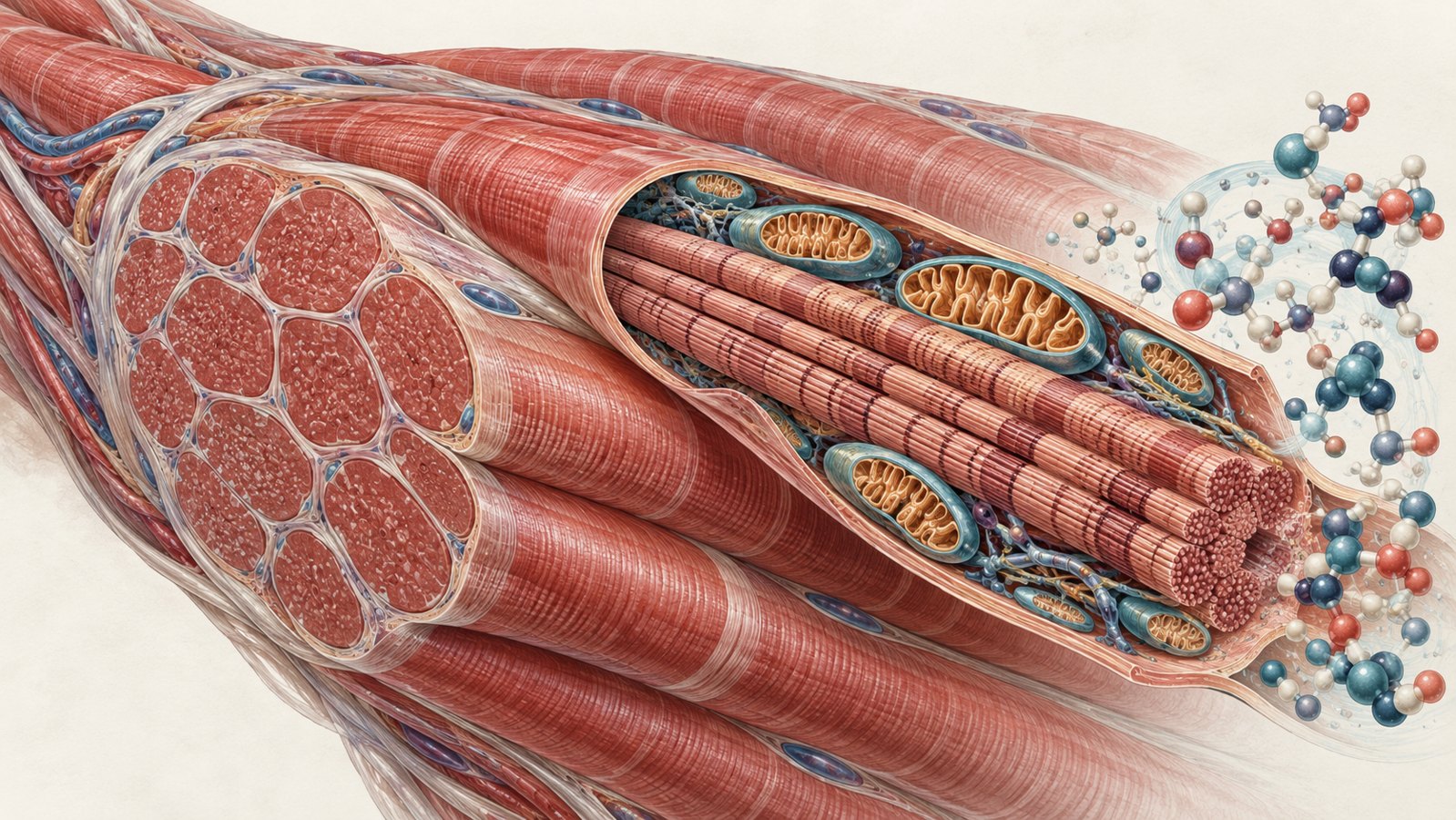
Preserving muscle with age involves more than keeping its fibres large. Muscle cells must also produce energy, maintain internal machinery and respond to damage. Experimental research offers a clue to how metabolism might influence those tasks.
Inhibiting GLS1 improved mitochondrial measures in cultured muscle precursor cells and muscle performance in mice with premature aging. This is early research, not evidence of a treatment for muscle weakness in people.
A connection between metabolism and muscle
GLS1, or glutaminase 1, helps break down the amino acid glutamine into glutamate, releasing ammonia. It belongs to a wider metabolic network. Changing an enzyme’s activity can affect several processes, which is why a promising target needs careful testing.
Mitochondria help convert nutrients into usable cellular energy. Their electron transport chain is a sequence of protein complexes that supports production of ATP, the cell’s energy currency. Muscle contraction demands energy, so mitochondrial function is one aspect of muscle health. Sarcopenia, the age-related loss of muscle mass and strength, has multiple contributing causes.
What happened in cells and mice
Hamsa Vardini Senthil Kumar and colleagues studied human myoblasts, cells that can form muscle fibres. Senescent cells had higher GLS1 activity and accumulated urea. CB-839, a GLS1 inhibitor, reduced urea and improved mitochondrial respiration. Senescence is a persistent state of cell-cycle arrest, often accompanied by altered cellular behavior.
Ten-month-old progeria-model mice received CB-839 or vehicle for one month. Treated mice showed improved muscle structure, contraction, walking speed and hanging endurance. Individual animal assays were small, typically involving four to eight animals per group.
Why the model matters
These mice carry a lamin A mutation associated with accelerated aging. Such models help researchers test mechanisms, but cannot represent the full complexity of ordinary human aging. Cultured human cells also do not show how a treatment will behave in a living person.
A stronger contraction in a short animal experiment is different from lasting improvement in mobility, independence or quality of life. Clinical outcomes require their own evidence.
What remains to be tested
The study did not treat people. CB-839, also called telaglenastat, has been investigated in cancer trials, which does not establish safety or efficacy for muscle aging. Higher concentrations harmed cell viability; the working concentration did not eliminate a standard senescence marker.
Further research should establish reproducibility, test naturally aging animals, examine sex differences and assess longer-term effects. Any proposed clinical use would then need appropriate safety studies and controlled human trials. The finding identifies a research direction, not an available or proven way to reverse muscle aging.
Original research
Senthil Kumar HV and colleagues. Inhibiting Glutaminase Reverses Senescence-Associated Mitochondrial Dysfunction and Skeletal Muscle Decline. Aging Cell, October 7, 2026. Read the complete open-access paper.