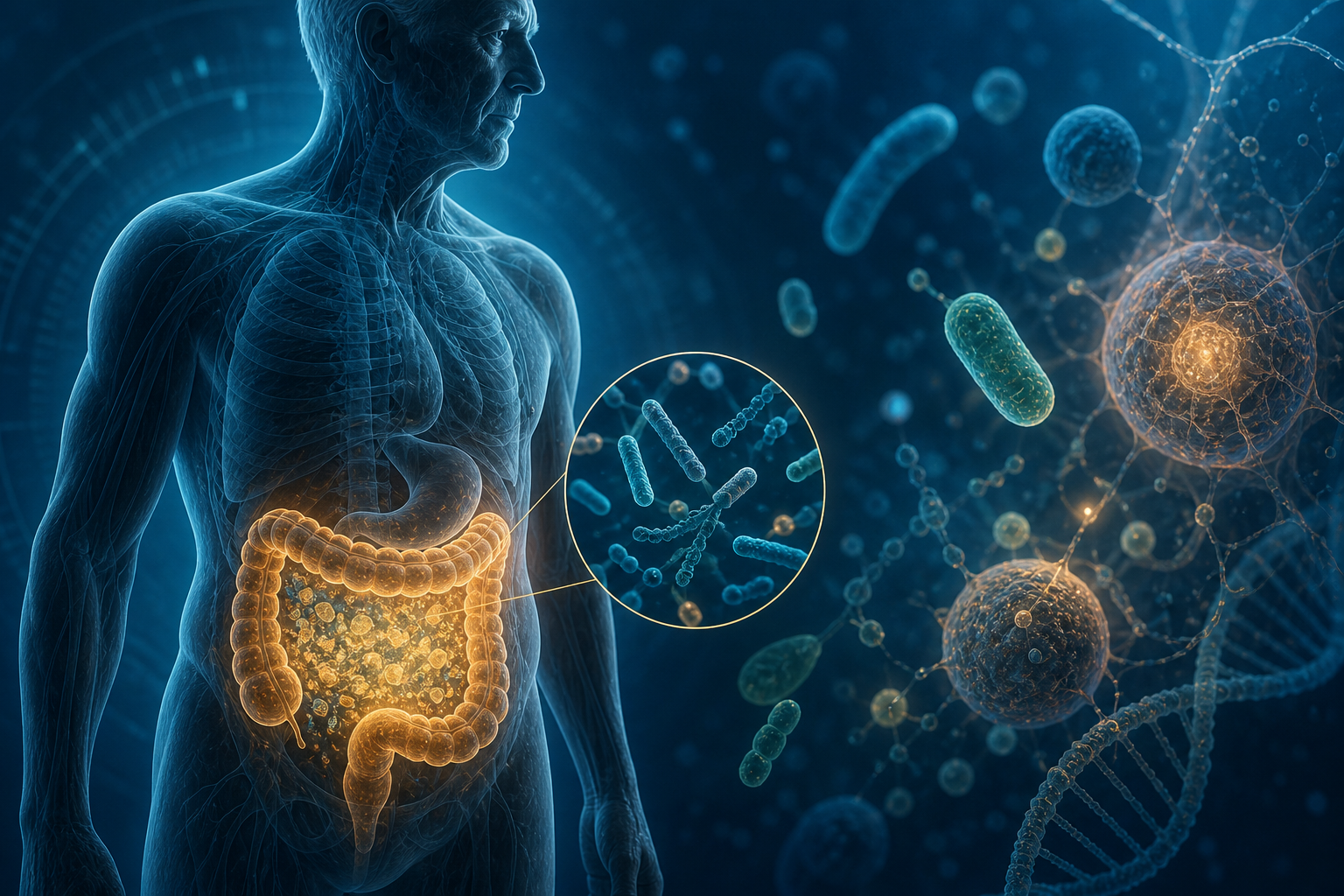
A gut bacterium that becomes less common with age improved intestinal health, inflammatory markers and physical and cognitive performance when researchers gave it to old mice. The result is intriguing. It is not evidence that a probiotic supplement can extend human healthspan.
In a Nature Aging study published August 25, researchers compared age-related changes in the human gut microbiome, then tested one candidate bacterium in naturally aged mice. The organism, Bifidobacterium pseudocatenulatum, was consistently depleted with age across men and women in several Chinese cohorts.
From an age signal to an intervention
The human finding was observational. People of different ages carried different microbial communities, and the researchers used those patterns to build a microbiome-based age model called MicroAge. That can reveal an association between age and a bacterium. It cannot show that losing the bacterium causes aging, or that restoring it will make a person healthier.
The causal experiment took place in mice. The team gave B. pseudocatenulatum orally to naturally aged animals. Compared with untreated old mice, the treated animals showed improvements in intestinal homeostasis, including measures related to the gut barrier and microbial balance. They also had lower inflammatory signals across multiple organs and performed better on tests of cognition and movement.
Those are healthspan-relevant outcomes because they ask whether an old animal functions better, not only whether a molecular marker changes. Still, mouse performance tests are not clinical outcomes, and the biology, dose and microbial ecology may not translate to people.
A possible metabolite link
The researchers also focused on 5-aminovaleric acid betaine, or 5-AVAB. Levels of this microbial metabolite declined with age in the human data. Supplementing old mice with 5-AVAB reproduced part of the bacterium’s systemic benefit, supporting a possible mechanism that connects the microbe to inflammatory and functional changes.
That does not establish 5-AVAB as the only active ingredient. A living microbe can affect many metabolites, other organisms and immune pathways at once. Nor does the experiment establish a safe or effective human dose.
What the study actually established
- In people: the bacterium and 5-AVAB were associated with age across the studied cohorts.
- In old mice: giving the bacterium improved several gut, inflammatory and functional measures.
- Mechanistically: 5-AVAB appears to explain part, but not necessarily all, of the effect.
- Not established: prevention of age-related disease, longer life or improved healthspan in humans.
Why the supplement aisle is a leap too far
Probiotics are strain-specific interventions. A product that lists the same species name may not contain the strain used in this study, the tested amount, or a formulation capable of delivering viable organisms to the gut. Manufacturing quality and an individual’s existing microbiome also matter.
The next persuasive step would be a controlled human trial that specifies the strain and dose, measures safety, confirms colonization or metabolic activity, and tests meaningful outcomes over enough time. Short changes in a microbiome score would be less informative than changes in validated health measures.
Bottom line: This is a well-motivated preclinical result connecting a human aging signal to an intervention in old mice. It earns attention as a research lead, not a shopping recommendation.
Primary source: Nature Aging, August 25, 2026