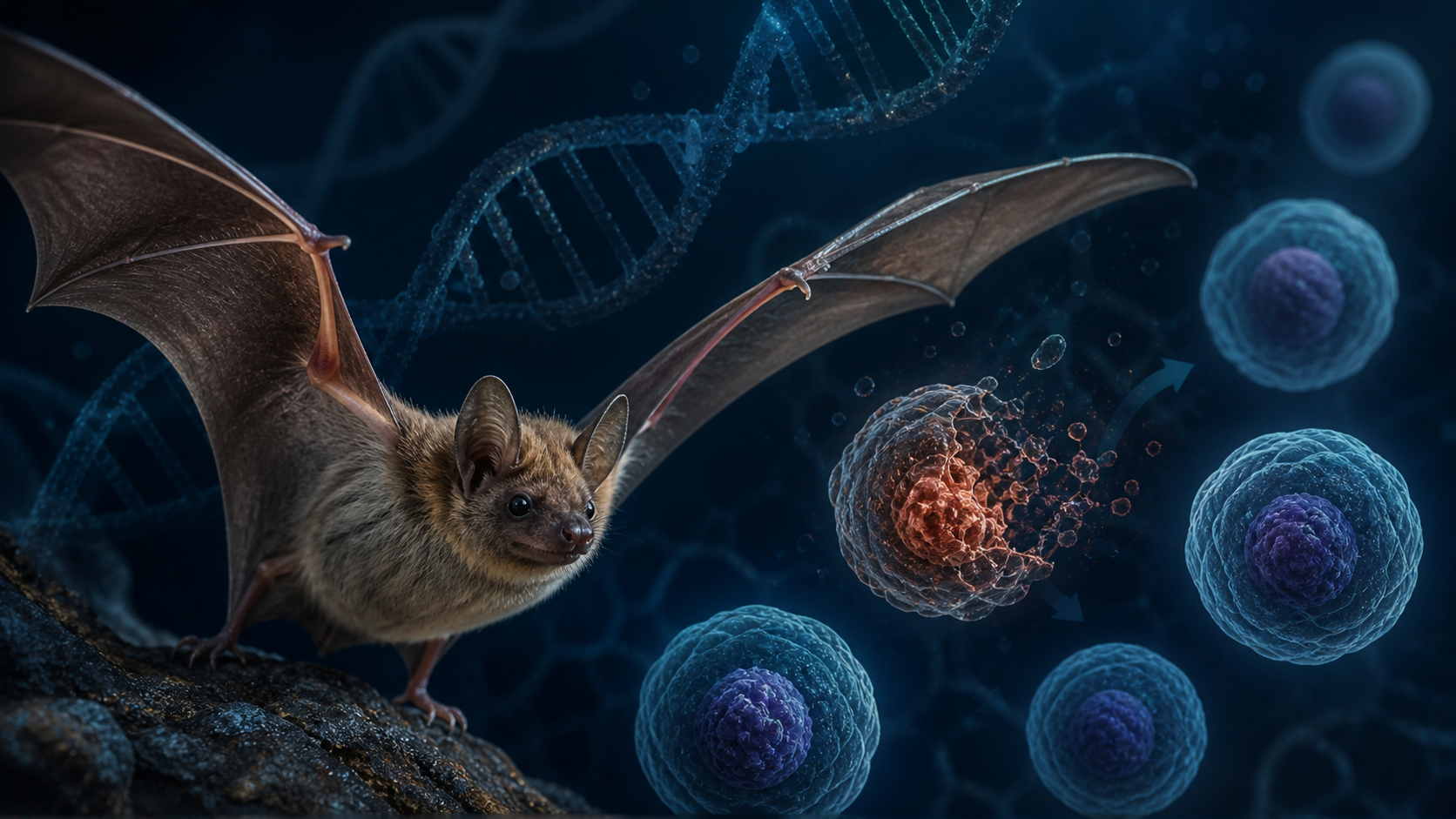
Some bats live for decades despite weighing little more than a few coins. A new comparison of eight closely related Myotis species suggests that part of their longevity may come from a strict response to dangerous cellular damage: when a cell is too compromised to keep, eliminate it.
The longevity paradox of bats
Body size is one of the strongest predictors of lifespan across mammals. Small animals generally live fast and die young, while larger animals tend to live longer. Bats are a striking exception. After accounting for body size, they are among the longest-lived mammals.
The genus Myotis makes that puzzle especially useful. Its species are close relatives and are similar in size, yet their recorded lifespans vary dramatically. Brandt’s bat, Myotis brandtii, has lived for 42 years, while Myotis nigricans has a maximum recorded lifespan of about seven years. Comparing close relatives helps researchers narrow the search for biological differences that may have evolved alongside longer life.
Eight genomes, one natural experiment
In a study published in Nature on August 26, 2026, an international team assembled near-complete genomes for eight Myotis species. The researchers combined those genomic comparisons with primary cell cultures, allowing them to test whether evolutionary signals in DNA were reflected in how living bat cells responded to stress.
The genomes showed extensive structural variation, including gene duplications and other changes that can alter how much of a protein is produced. The team also found strong evidence that viruses have shaped bat evolution. Genes that interact with DNA viruses showed signs of positive selection, meaning genetic variants affecting those genes appear to have been favored over evolutionary time. Genes that interact with RNA viruses were especially dynamic in copy number.
One example involved PKR, an immune protein that detects double-stranded RNA and can shut down protein production inside an infected cell. Several Myotis species carried ancient duplicated versions of the PKR gene. Those copies did not simply make the antiviral response stronger in every test. Instead, the results suggested a long-running evolutionary trade-off between viral restriction and cellular toxicity.
Where immunity, cancer and aging meet
The longevity analysis pointed toward another overlap. Lineages with some of the greatest increases in lifespan were enriched for genetic changes in cancer-related pathways. In the long-lived little brown bat, Myotis lucifugus, genes involved in repairing DNA double-strand breaks were particularly prominent.
This connection matters because a longer life gives cells more time to accumulate mutations. Across species, however, long-lived animals do not experience the enormous increase in cancer that would be expected from their greater lifetime number of cell divisions. This mismatch is known as Peto’s paradox. It implies that long-lived species have evolved additional ways to suppress cancer.
The new bat study does not show that one gene or pathway explains exceptional longevity. It does suggest that immune defense, DNA-damage control and cancer suppression may have been shaped together. A gene can affect several traits at once, a phenomenon called pleiotropy, so adaptations to pathogens may also influence how cells handle age-related damage.
What happened when researchers damaged bat cells
To move beyond association, the researchers exposed skin fibroblasts from five bat species to neocarzinostatin, a drug that causes DNA double-strand breaks. Fibroblasts are connective-tissue cells that can be grown in the laboratory.
At a low dose, cells from M. lucifugus were the only ones to show reduced viability after 24 hours together with increased apoptosis. Apoptosis is an orderly form of programmed cell death. At higher doses, the same species showed the greatest loss of viability and the highest level of apoptosis among the bats tested.
Gene-activity measurements supported that interpretation. After DNA damage, the little brown bat cells increased activity in genes involved in cell-cycle arrest and cell death, including CDKN1A and BAX, while reducing activity in pathways tied to cell division and growth.
Repair or destroy?
It may sound counterintuitive for long-lived animals to have cells that are more willing to die. But a severely damaged cell can be more dangerous if it survives. It may acquire cancer-promoting mutations, malfunction, or enter senescence, a state in which it stops dividing but can release inflammatory signals.
A strict quality-control system could therefore favor the organism even when it sacrifices individual cells. Similar ideas have emerged from work in elephants, which have additional copies of tumor-suppressor genes and can activate apoptosis after DNA damage. Researchers have also connected efficient removal of damaged cells with longevity in naked mole rats and bowhead whales.
The comparison is a biological analogy, not proof that these animals use identical mechanisms. The bat experiments involved cultured skin cells, not whole animals, and the study did not manipulate apoptosis to see whether it changed lifespan or cancer incidence.
What this could mean for aging biology
Comparative biology can reveal solutions that evolution has already tested. Myotis bats are particularly informative because substantial lifespan differences evolved among close relatives without equally dramatic changes in body size.
The new genomes provide a resource for investigating how antiviral defenses, cancer suppression and cellular stress responses intersect. They also strengthen a broader idea in geroscience: healthy longevity may depend not only on repairing damage, but also on recognizing when repair is no longer safe.
Translation to humans is uncertain. Increasing apoptosis indiscriminately could damage tissues, impair healing and deplete cells that cannot easily be replaced. Any useful intervention would need to distinguish truly dangerous cells from recoverable ones and act in the correct tissue at the correct time.
What the study does not prove
- It does not show that the identified genetic changes cause longer lifespan.
- It does not demonstrate lifespan extension or cancer prevention in bats, mice or humans.
- It does not establish that stronger apoptosis is the complete explanation for bat longevity.
- It does not identify a drug or treatment that safely reproduces the bat response in people.
The Lifespan Brief verdict
This is compelling comparative longevity biology. Closely related bats with large lifespan differences provide an unusually informative natural experiment, and the combination of near-complete genomes with functional cell testing makes the study stronger than a genomic association alone. The damaged-cell response in M. lucifugus is especially intriguing, but it remains a laboratory finding in bat fibroblasts. It is far removed from demonstrating a human anti-aging intervention.