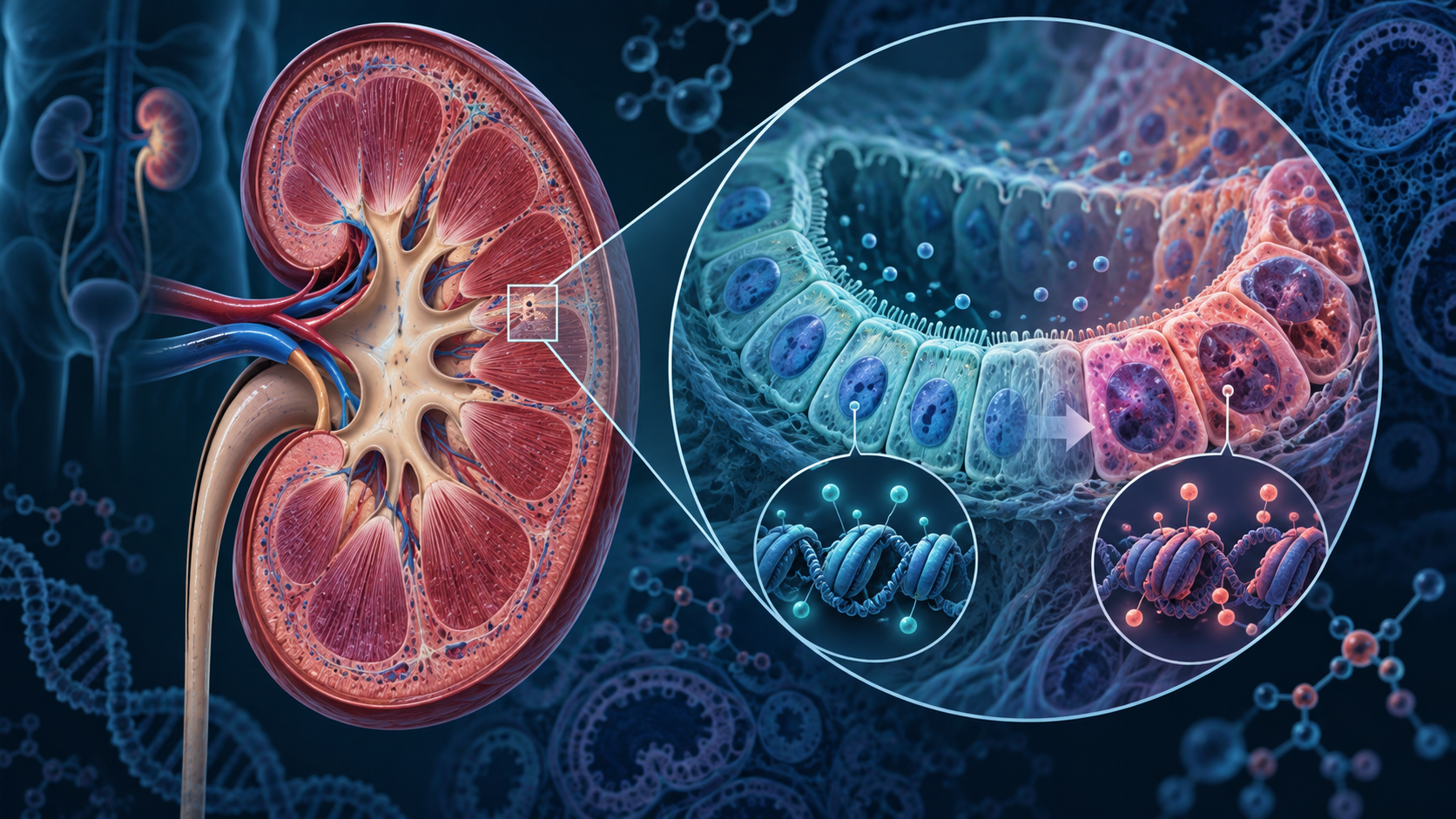
The bottom line: A new single-cell atlas found that chronic kidney disease was associated with aging-like molecular changes concentrated in tubular epithelial cells, the cells that line much of the kidney’s filtering and transport system. The pattern was strongest in damaged areas that had failed to complete normal repair. It does not mean that every kidney cell had aged faster, or that chronic kidney disease is simply accelerated aging.
Evidence at a glance
- Study type: Human and mouse single-cell multiomics resource.
- Human samples: 12 donors, including seven people with kidney disease and five age-matched reference tissues.
- Core data: 57,619 single-cell DNA methylation profiles, supported by gene-expression, chromatin-accessibility, spatial-transcriptomic and three-dimensional genome measurements.
- Main finding: Disease-associated epigenetic age acceleration was most pronounced in tubular epithelial cells.
- Evidence level: Early mechanistic human tissue research. It identifies a disease-associated cell state, not a treatment or a clinical aging test.
What an epigenetic state means
Every cell contains essentially the same DNA, but a kidney tubule cell uses a different set of genetic instructions than a nerve or immune cell. The epigenome helps manage that choice. Chemical marks on DNA and the way DNA is packaged can make particular regions easier or harder for a cell to use without changing the underlying sequence.
Those controls can shift with age, injury and disease. In this study, researchers measured DNA methylation, one type of epigenetic mark, cell by cell. They also examined which genes were active, which parts of the genome were accessible and how sections of DNA were organized in three dimensions.
The result is more detailed than a bulk tissue measurement. A kidney contains epithelial, immune, endothelial and connective-tissue cells, among others. Mixing them together can hide which populations are driving a signal. The single-cell atlas allowed the researchers to separate those contributions.
The signal centered on tubular epithelial cells
The strongest disease-associated shift appeared in tubular epithelial cells. These cells line the kidney’s tubules, where water, salts and other molecules are reclaimed or secreted after blood is filtered. They perform demanding transport work and are frequently exposed to metabolic stress and injury.
After an acute injury, surviving tubular cells can temporarily change state, proliferate and help rebuild damaged tissue. Ideally, that repair program resolves and the cells return to a stable identity. In chronic disease, some cells can remain caught in a maladaptive repair state. They lose parts of their specialized program, produce inflammatory or fibrotic signals and contribute to an environment that makes recovery harder.
The new atlas connects that unresolved repair state with aging-like epigenetic and transcriptional patterns. Spatial mapping placed the altered cells in pathological tissue niches, rather than showing a uniform change across the organ. The researchers also observed reorganization of higher-order chromatin structure and reduced local methylation integrity, changes that could make it harder for tubular cells to preserve their normal identity.
Why this matters for aging biology
Aging is often discussed as if an organ becomes uniformly older. This study supports a more local view. Disease can push certain vulnerable cell populations toward molecular states that resemble aspects of aging while neighboring cells follow different trajectories.
That distinction could help explain why chronological age, organ function and molecular age do not always move together. It may also help researchers identify which cells need to be protected or redirected during repair. A therapy that restored healthy epithelial identity could, in principle, matter more than one that shifted an average score across the whole kidney.
The cross-species design adds useful context. Human disease samples were compared with young and aged mouse kidneys, allowing the team to look for patterns shared by injury and normal aging. Shared patterns can point to conserved biology, but mice and humans still differ, and similarity does not establish that the same process has the same cause in both species.
What the study does not show
An epigenetic clock estimate is a statistical summary of methylation patterns. It is not a stopwatch inside a cell, and a higher estimate does not prove that a cell has undergone every feature of biological aging.
Injury, inflammation, cellular stress and loss of a mature cell identity can produce overlapping molecular signatures. The authors therefore describe an aging-like state rather than claiming definitive accelerated aging or cellular senescence. The study also used a modest number of human donors and analyzed tissue collected during clinical care, not people followed through treatment.
No intervention was tested. The findings do not show that changing methylation will reverse chronic kidney disease, improve filtration or extend life. They also do not justify using a kidney epigenetic clock in routine care.
The Lifespan Brief assessment
This is a technically ambitious map of how kidney disease and aging intersect at the level of individual cell types. Its most useful lesson is one of specificity: the disease-associated aging signal was not evenly distributed. Tubular epithelial cells in unresolved repair carried much of it.
The work strengthens the case for studying aging as a collection of cell states shaped by tissue context. It does not reduce chronic kidney disease to aging, and it does not yet identify a therapy. The next step is to test whether these states predict progression, whether they can be changed safely and whether changing them improves kidney function.
Primary source
A cross-species single-cell kidney epigenome atlas reveals epithelial-dominant aging-like states in disease, Nature Aging, September 24, 2026.
This article is for general information and is not personal medical advice.