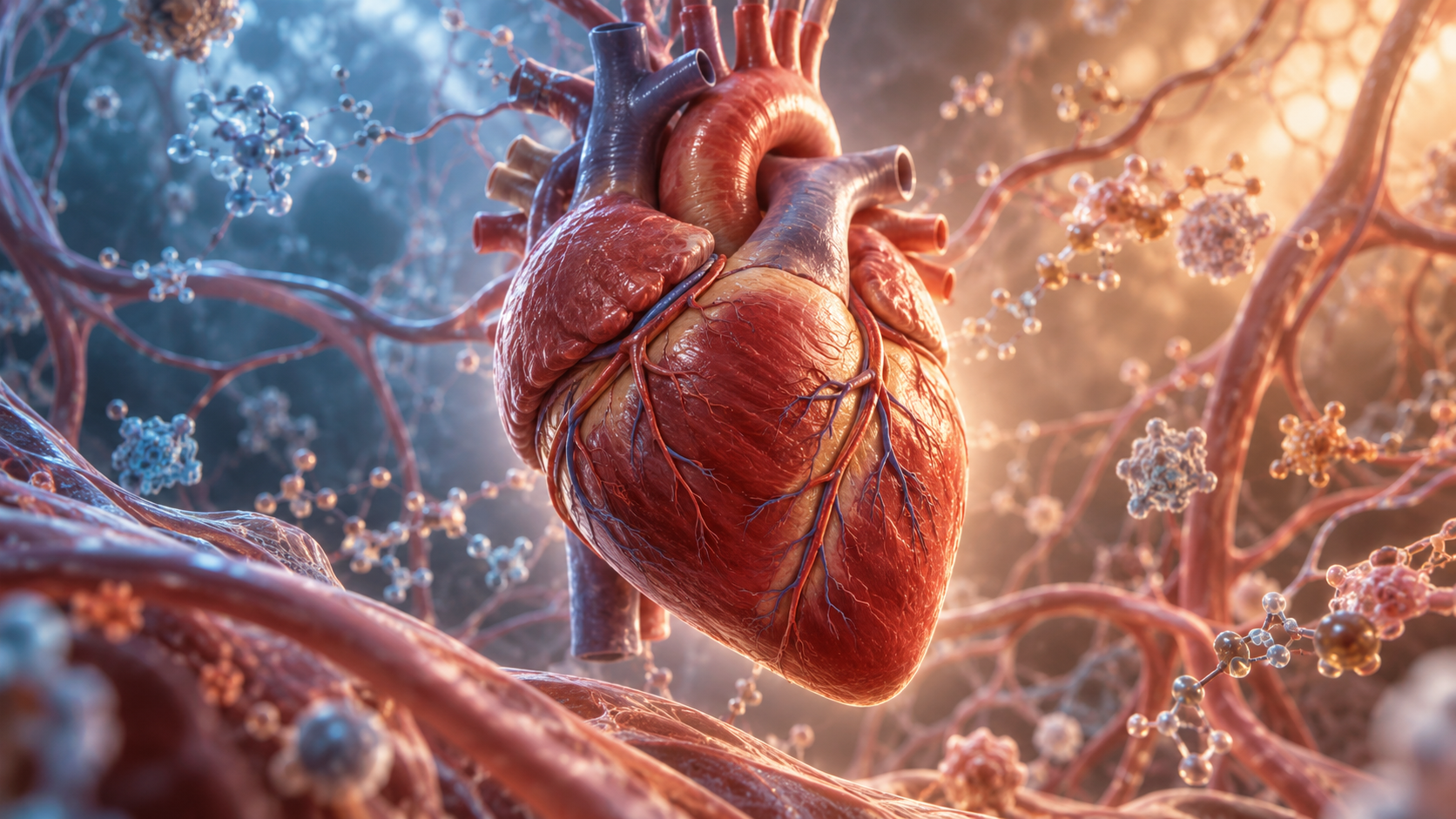
Age-mismatched transplants offer a window into how the body shapes tissue aging. The findings include human data, but the study is a preprint and has not been peer reviewed.
A donated heart arrives with a history. It has spent years inside one person before beginning work inside another. A new study raises a question that reaches beyond transplantation: how much of an organ’s biological age belongs to the tissue, and how much reflects the body around it?
Researchers report that transplanted hearts showed aging signatures closer to the recipient’s age. Older hearts in younger recipients showed more youthful signatures, while younger hearts in older recipients shifted in the opposite direction. The work combines mouse experiments with analyses of human heart transplants.
The study was posted on bioRxiv as a preprint, meaning it has not yet undergone peer review. It is an intriguing research finding, not established evidence that transplantation reverses aging.
What biological age means
Chronological age is time since birth. Biological age is an estimate of how old cells or tissues appear based on measurable features of their condition. Researchers can look at patterns of gene activity or chemical marks on DNA called methylation. Aging clocks use such patterns to estimate age.
These estimates are useful research tools, but they are not a literal reading of years remaining. A younger-looking molecular signature does not by itself prove that an organ has regained all the function or resilience of younger tissue.
What the transplant findings suggest
The authors studied transplants across an age gap between donor and recipient. In mice, DNA methylation and gene-expression measurements supported shifts in graft aging signatures toward the recipient’s age. They found little reciprocal effect on the recipient’s systemic biological age.
The human analyses linked transplanted heart biological-age estimates more strongly to recipient age than donor age. These clinical observations support the possibility that the surrounding body influences tissue aging. They do not provide the same causal certainty as a controlled animal experiment.
Why aging researchers care
If tissue aging is partly shaped by its environment, researchers have another question to test: which features of that environment matter? Circulating signals, immune activity and metabolic conditions are plausible avenues to investigate. The study does not identify a ready-to-use rejuvenation treatment.
The distinction could help guide experiments. Scientists would need to isolate candidate influences, change them deliberately, and check whether molecular shifts are accompanied by lasting improvements in tissue function. A biomarker finding is a starting point for that work.
Caveats and reasons for caution
Peer review may change the analysis or its interpretation. Human transplant recipients also have illnesses, medications and immune-related complications that make their biology more complex than a standardized mouse experiment. The authors note that the mouse model does not reproduce the immune response of clinical transplantation.
It would therefore be premature to treat recipient age as the sole explanation, or to assume all tissues behave this way. Independent replication, larger human studies and longer follow-up would help establish how reliable and durable the association is.
The findings do not demonstrate longer human life, whole-body rejuvenation or a reason to change organ-allocation practice. Decisions about donor hearts must still depend on clinical evidence about safety, function and outcomes.
The takeaway
The preprint suggests that an organ’s aging signatures can respond to the body it enters. That makes the systemic environment an interesting subject for aging research. Whether those shifts translate into lasting clinical benefits remains an open question.
Source: Transplanted hearts assimilate the recipient’s biological age, bioRxiv preprint; PubMed record.
Editorial note: This is The Lifespan Brief’s first published article on this study. An earlier scan mention was not a published site story.