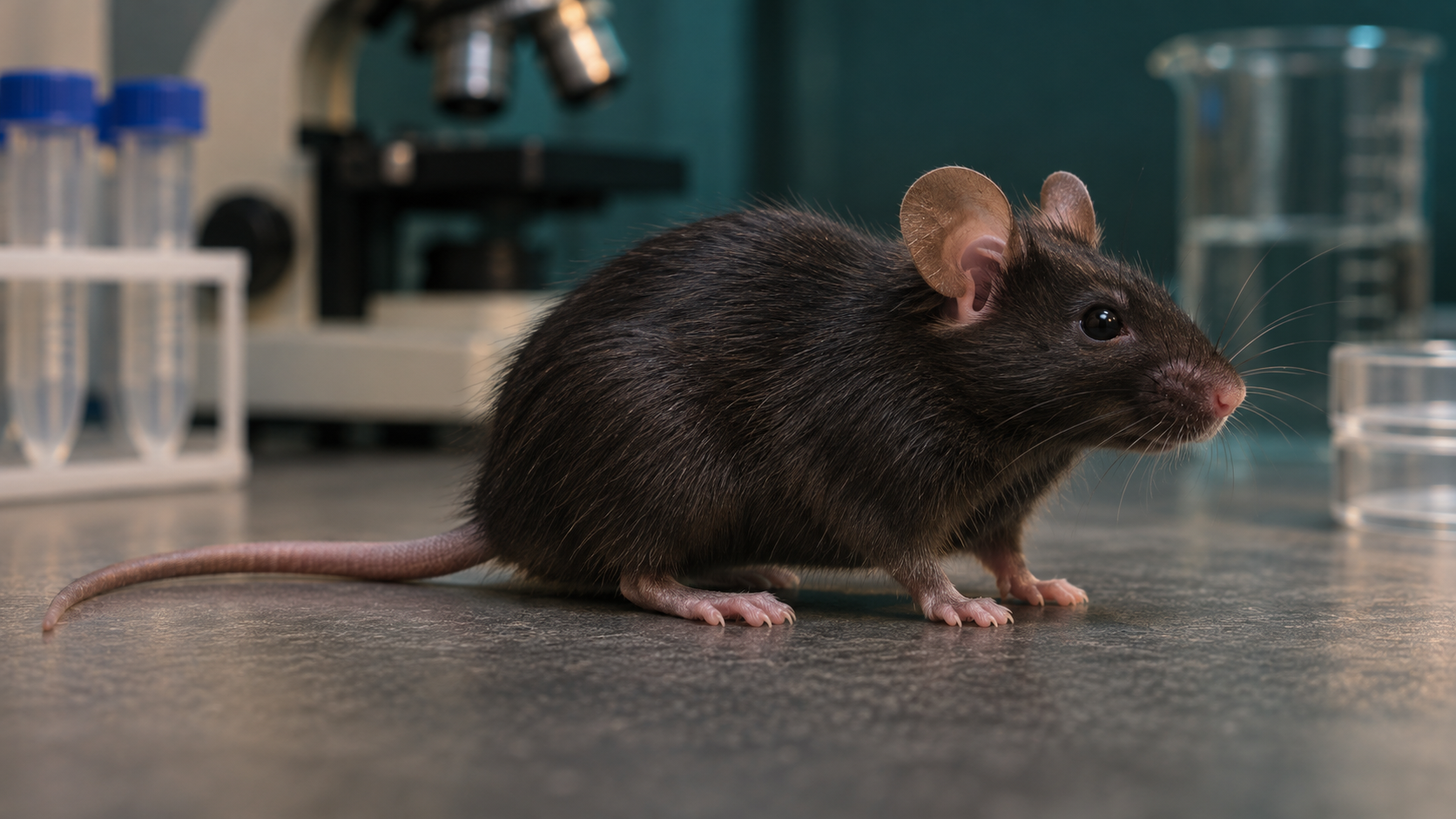
Mice that began receiving an experimental drug at about 18 months of age lived to an average of 28 months, compared with 24 months for mice on standard chow. The treated mice also accumulated signs of frailty more slowly and performed better on several physical and memory tasks. The experiment involved 52 mice in the survival comparison, and the two groups may have eaten different amounts of food.
Menghan Yang and colleagues tested a compound called #11a, which inhibits an enzyme known as asparagine endopeptidase, or AEP. The peer-reviewed study in iScience used naturally aged laboratory mice. Starting treatment late in life allowed the team to test whether blocking the enzyme could affect outcomes after age-related decline had already begun.
Four months on average
The survival experiment compared 26 C57BL/6 mice receiving standard chow with 26 receiving chow containing #11a. The feed contained 56 milligrams of the compound per kilogram of chow, an estimated intake of about 7.5 milligrams per kilogram of body weight per day in the mice. Both males and females participated. The study generally pooled the sexes for analysis and lacked the statistical power to test for sex differences across all outcomes.
The four-month difference represents about a 17% increase over the control group’s average survival age, based on the rounded ages reported in the paper. These figures describe the mean. The paper did not report a median or formally establish an increase in maximum lifespan. The estimated hazard of death in controls was 2.08 times that in treated mice, with a 95% confidence interval of 1.02 to 4.27 and a p value of 0.0454. The comparison met the usual threshold for statistical significance, though the wide interval leaves the size of the effect uncertain.
How the mice fared as they aged
Every four weeks, evaluators who were blinded to treatment scored 29 signs of frailty. The checklist included changes in the coat, hearing, grip, movement and body condition. Frailty scores rose more slowly in treated animals of both sexes. Some individual measures differed by sex. Among females, changes included less severe gait problems and grip weakness. Among males, the researchers reported less severe cataracts and fewer changes in coat colour. The separate frailty results do not establish whether one sex benefited more from the drug.
After five months, treated mice hung on longer in a wire-hang test and performed better on some treadmill measures. The endurance measure showed a trend towards improvement. In groups of 12 mice, treatment also improved performance on a novel-object recognition task and a Y-maze task used to assess spatial working memory. The object-recognition discrimination index averaged 48% in treated animals and 32% in controls. Treated mice also moved more in an open arena, which made it difficult to separate changes in activity from changes in anxiety-like behaviour in that test. These experiments measured specific functions in mice.
Why target a protein-cutting enzyme
AEP, also called legumain, cuts proteins at sites containing the amino acid asparagine. It normally works mainly in acidic compartments called lysosomes, where cells break down and recycle material. Earlier research had linked unusually high AEP activity to tissue stress and to the cleavage of proteins involved in neurodegenerative disease. The new study tested whether lowering its activity would affect aging more broadly in animals without a genetically engineered disease.
In brain tissue, the researchers measured lower AEP activity in mice receiving #11a. They also found less cleavage of NAMPT, an enzyme that helps cells make NAD+, a molecule involved in energy metabolism. The ratio of NAD+ to its reduced form, NADH, rose in brain, muscle, liver and kidney tissue. Levels of the NAD+-dependent protein SIRT1 were higher in brain and muscle. These results show that the drug changed the pathway alongside the survival and frailty results. The experiment did not establish that those molecular changes were necessary for the mice to live longer.
The effect of food intake is still unresolved
Treated cages recorded lower food intake at several points. A comparison covering the first five months did not find a statistically significant difference, but the researchers could measure consumption only for a whole cage. They could not link an individual mouse’s food intake to its survival or frailty. An experiment that gives control animals the same amount of food eaten by treated animals would help establish how much of the effect came from the compound.
At the five-month check, the team saw no overt abnormalities on examination of several major organs, and routine blood counts did not show major changes. Those checks were limited in scope and timing. The authors called for more comprehensive long-term safety testing. The work was supported by Chinese national and Shenzhen research programmes. Senior author Keqiang Ye disclosed that he is an inventor on patent applications related to AEP inhibitors.
Independent studies in larger groups could test whether the survival result holds in other mouse strains and whether it differs by sex. A human trial would also need a better account of how the drug behaves in the body, which dose could inhibit the target and what sustained inhibition does to healthy tissues. For now, the result is a survival difference in one mouse experiment, with food intake still a plausible contributor.
Original research Yang and colleagues, iScience (2026). Open full text and supplementary figures.