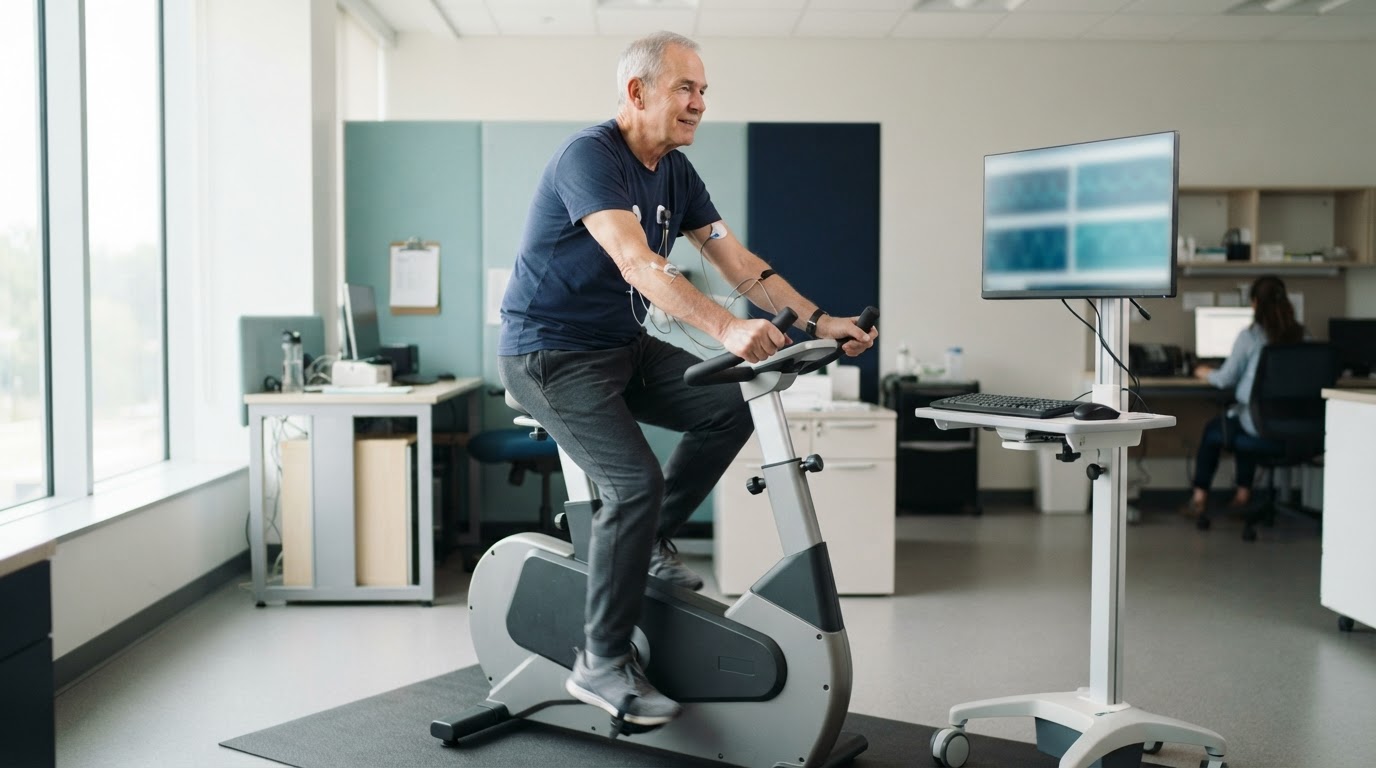
Older adults who combined aerobic exercise with cognitive training showed less thinning in a set of brain regions in two comparisons from a small randomized trial. The differences emerged months after supervised training ended, and they depended on how researchers handled missing scans. The study, published in JAMA Network Open, examined brain structure in people with memory difficulties.
Who took part and what they did
The analysis drew on a trial that randomized 146 adults with amnestic mild cognitive impairment, at an average age of about 74. Amnestic means that memory is the main area of difficulty. People with mild cognitive impairment can generally still manage everyday activities independently, whereas dementia interferes with that independence. The trial diagnosed the condition clinically and did not confirm Alzheimer’s pathology with amyloid or tau testing.
Participants spent six months in one of four supervised groups. One combined stationary cycling with computerized exercises designed to improve how quickly people process information. Two groups did one activity by itself, cycling or speed-of-processing training. A fourth group combined stretching with mentally engaging leisure activities. MRI scans were taken at the start, after the intervention, and at 12 and 18 months from baseline.
What the MRI measurements mean
One measure averaged the thickness of four areas of the brain’s outer layer on each side. These include areas in and around the temporal lobe that tend to thin in Alzheimer’s disease. Researchers call the composite Alzheimer’s disease signature cortical thickness. It gives them a way to track structural change across a set of regions, but it does not diagnose Alzheimer’s or measure how well someone remembers a conversation or manages daily tasks.
The other main measure captured the volume of white matter hyperintensities. These are bright spots on certain MRI scans, often associated with changes in the small blood vessels that supply the brain. Their volume offers a different view of brain health from the thickness of the cortex.
Where the groups differed
In the main analysis, participants who did cognitive training alone showed 0.060 mm more thinning on the cortical measure at 18 months than those who combined it with exercise. At 12 months, the stretching and mental leisure group showed 0.066 mm more thinning than the combined group. The main analysis did not detect a clear difference between combined training and cycling alone on that measure. It also found no statistically significant differences between groups in white matter hyperintensity volume.
Those comparisons used statistical estimates for missing follow-up values. Only 74 participants had the data used in the 18-month analysis of cortical thickness based on available scans. When the researchers analysed only observed scans, neither of the two cortical-thickness findings reached statistical significance. The difference between the analyses could reflect the smaller sample, who returned for scanning or the assumptions used to estimate the missing values. A separate result for white matter also depended on the analytic method.
All four groups did some form of structured activity, so the study could not compare the combined programme with usual care. It also did not establish whether the observed differences corresponded to better memory, more independence or a lower likelihood of dementia. Follow-up research could test those outcomes directly while repeating the imaging measurements in larger and more diverse groups.
The timing also matters for how a future trial should be designed. If researchers took scans only at the end of the six-month programme, they would miss the visits at which the two main differences appeared. With fewer people returning for later scans, those visits also became harder to interpret. A larger study could plan for that loss to follow-up and collect measures of memory and daily function alongside scans at the same visits.
Exercise and cognitive training address different aspects of healthy ageing, which gives researchers a reason to test them together. In this trial, the comparison with cycling alone did not show a clear cortical-thickness benefit. That leaves open whether the extra training contributed to the imaging signal and whether the added time would be worthwhile for participants.
Primary source: JAMA Network Open original study, November 18, 2026.
The Takeaway
Putting exercise and cognitive training together produced a signal worth testing again, concentrated in a particular MRI measure and at specific follow-up visits. For people living with memory difficulties, the question is whether the combination makes a lasting difference to memory or independent living. This analysis leaves that question open.