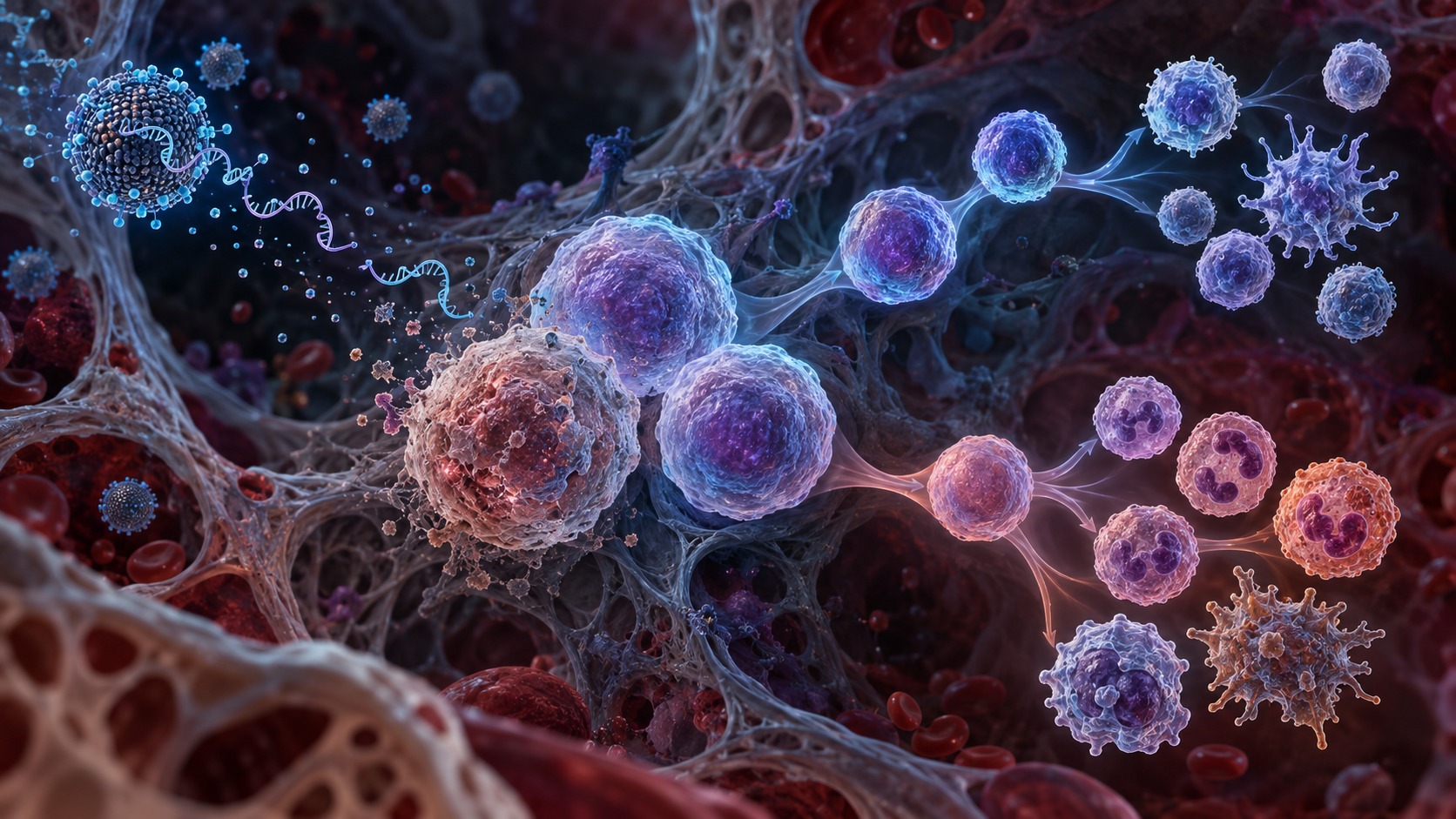
Researchers have identified a population of aging blood-forming stem cells that appears unusually resistant to programmed cell death. In a new Signal Transduction and Targeted Therapy study, suppressing the survival protein BIRC6 shifted blood and immune-cell production toward younger patterns and improved vaccine responses in middle-aged mice. Human stem cells were also studied outside the body, but no person received the experimental treatment.
The finding at a glance
- Target: BIRC6, a protein that inhibits apoptosis.
- Proposed mechanism: bone-marrow regulatory T cells transfer cAMP to aging hematopoietic stem cells, activating PKA and CREB and increasing BIRC6.
- Intervention: stem-cell-targeted lipid nanoparticles carrying an antisense oligonucleotide designed to reduce BIRC6.
- Main evidence: immune and blood-cell changes in middle-aged male mice, plus experiments in isolated human cells.
- What is missing: human dosing, clinical safety data and evidence of improved health in patients.
Why aging blood stem cells matter
Hematopoietic stem cells, or HSCs, reside mainly in bone marrow and continually generate red blood cells, platelets and immune cells. With age, the HSC pool expands but becomes less balanced. Production increasingly favors myeloid cells, while the lymphoid branches that generate B cells and T cells become less effective. This myeloid skew is associated with weaker adaptive immunity, chronic inflammation and increased risk of blood disorders.
A larger stem-cell pool is therefore not necessarily a healthier one. Some dysfunctional cells may persist because they have become harder to eliminate. The new study asks whether one survival pathway helps maintain that aged population, and whether reducing it can improve the output of the blood-forming system.
BIRC6 and the cell’s decision to die
Apoptosis is a controlled self-destruct program. Cells use it to remove themselves when they are badly damaged, no longer needed or potentially dangerous. It is distinct from a cell simply breaking apart after injury. Proteins that promote or restrain apoptosis maintain a balance between preserving useful cells and clearing harmful ones.
BIRC6 is an inhibitor of apoptosis. The researchers found that it was strongly increased in a subset of aging mouse HSCs. Cells with high BIRC6 also carried gene-expression patterns associated with HSC aging, reduced readiness to enter apoptosis and a bias toward myeloid production. Selectively allowing dysfunctional aged stem cells to survive could therefore reinforce an imbalanced blood system.
How regulatory T cells may protect aging HSCs
The proposed pathway begins with regulatory T cells, or Tregs, in the bone-marrow niche. These immune cells normally help control inflammation and can support stem-cell survival. The team found that bone-marrow Tregs expanded with age and formed more contacts with HSCs.
Through gap junctions, the Tregs transferred cyclic AMP, or cAMP, into aging HSCs. That signal activated protein kinase A, followed by the transcription factor CREB, which increased expression of BIRC6. In cell culture and mouse experiments, disrupting parts of this cAMP to PKA to CREB to BIRC6 chain reduced the survival advantage and aging-related features of the HSCs.
The interpretation is not that Tregs are broadly harmful. Their roles vary with context, and depleting them throughout the body would carry serious immune risks. The study instead proposes that a normally protective relationship becomes maladaptive in the aging marrow niche by preferentially preserving dysfunctional HSCs.
How the researchers targeted BIRC6
The team designed antisense oligonucleotides, short strands of nucleic acid that can bind a specific RNA message and reduce production of its protein. They selected an oligonucleotide that lowered BIRC6 and increased apoptotic priming in aged mouse HSCs.
For delivery, the oligonucleotide was packaged in lipid nanoparticles whose surface carried an antibody against CD117, a marker used to target HSCs. Twelve-month-old male mice received weekly treatment for four weeks. The animals were then followed long enough for newly generated immune-cell populations to be assessed.
A 28-day preliminary safety assessment found no difference in body weight or obvious pathological changes in major organs at the tested dose. That is useful short-term information from a small animal study. It cannot establish long-term safety, reproductive effects, cancer risk or the behavior of the delivery system in humans.
What changed in the mice
Treated middle-aged mice showed fewer myeloid-biased HSCs and more common lymphoid progenitors, the cells that give rise to major parts of adaptive immunity. Naive T cells and mature B cells increased, while several inflammatory, senescence and immunosenescence-related markers moved toward levels seen in younger controls.
The clearest functional test involved vaccination with SARS-CoV-2 spike protein. At 28 days after vaccination, treated middle-aged mice had antibody titres 22 times those of untreated middle-aged controls. Each group contained six mice. The treatment also improved germinal-center B-cell and memory B-cell responses. Antibody titres and germinal-center responses were not significantly different between treated middle-aged mice and young controls in the reported comparison.
The 22-fold figure is striking, but it comes from a small mouse experiment with one vaccine formulation. It does not predict the size of an effect in people, and antibody concentration alone is not a complete measure of protection, durability or immune safety.
What the human-cell experiments show
The researchers reanalyzed published single-cell data and found higher BIRC6 expression in HSCs from older human donors. They also isolated circulating HSCs from young and middle-aged donors. In samples from five donors, middle-aged HSCs showed higher BIRC6, lower apoptotic priming and stronger aging-associated gene signatures.
When those cells were treated with a human BIRC6-targeting antisense oligonucleotide outside the body, BIRC6 decreased, apoptotic priming increased and some aging-associated cell features weakened. This is ex vivo evidence. The cells were separated from donors and manipulated in the laboratory. People were not treated with BIRC6-targeting nanoparticles, and the experiment cannot show how a whole human immune system would respond.
The limitations and risks
- Mouse model: the main intervention evidence comes from 12-month-old male mice, not older adults.
- Preclinical delivery: antibody-modified lipid nanoparticles must be manufactured consistently, reach the intended cells and avoid unintended tissues.
- No human treatment data: the human work used isolated cells and existing datasets.
- Apoptosis risk: lowering a survival protein could remove dysfunctional cells, but excessive or mistargeted apoptosis could deplete healthy stem cells or damage tissue maintenance.
- Specificity: the paper reports modest changes in other apoptosis regulators, suggesting that the broader death-survival network may be affected.
- Long-term uncertainty: the study does not establish durable immune benefit, repeated-dose safety, cancer risk or effects under infection and other physiological stresses.
Further work will need longer studies, both sexes, disease and infection models, serial transplantation and direct tracking of targeted cells. Before clinical translation, researchers would also need a validated human formulation, toxicology studies and evidence that the intervention does not trade one form of immune dysfunction for another.
Bottom line
BIRC6 appears to help a dysfunctional population of aging blood stem cells resist normal clearance. Reducing it with targeted nanoparticles rebalanced blood-cell production and strengthened a vaccine response in middle-aged mice, while isolated human HSCs showed a related molecular response outside the body. This is a detailed preclinical mechanism study, not evidence that human immune aging has been reversed or that a treatment is ready for patients.
Source
Liao, Shao, Wang and colleagues. “Targeting BIRC6 rejuvenates hematopoietic stem cell aging and immunosenescence.” Signal Transduction and Targeted Therapy, published September 23, 2026. The paper reports no competing interests.